Lorentz Aerospace
MHD PROPULSION & SUPERCAVITATION
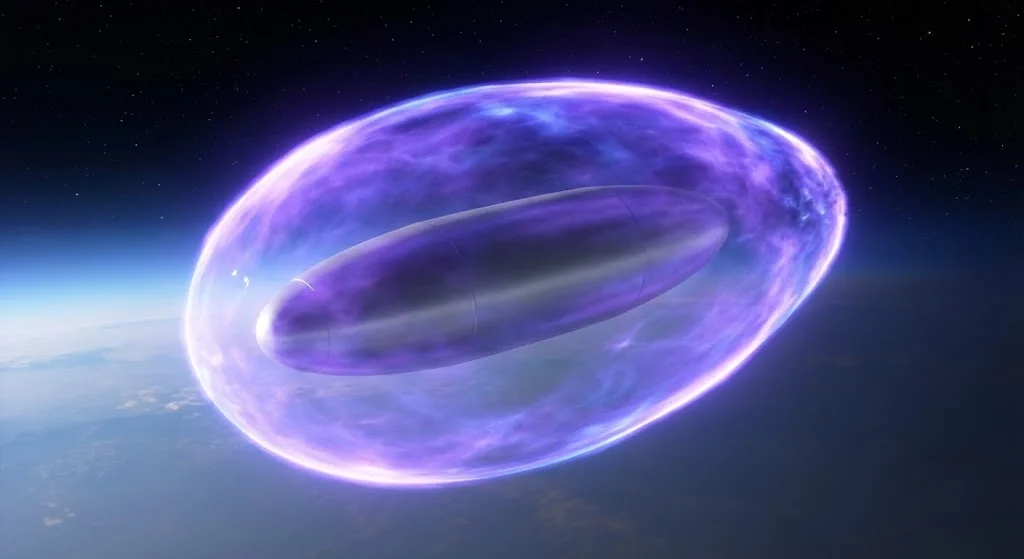
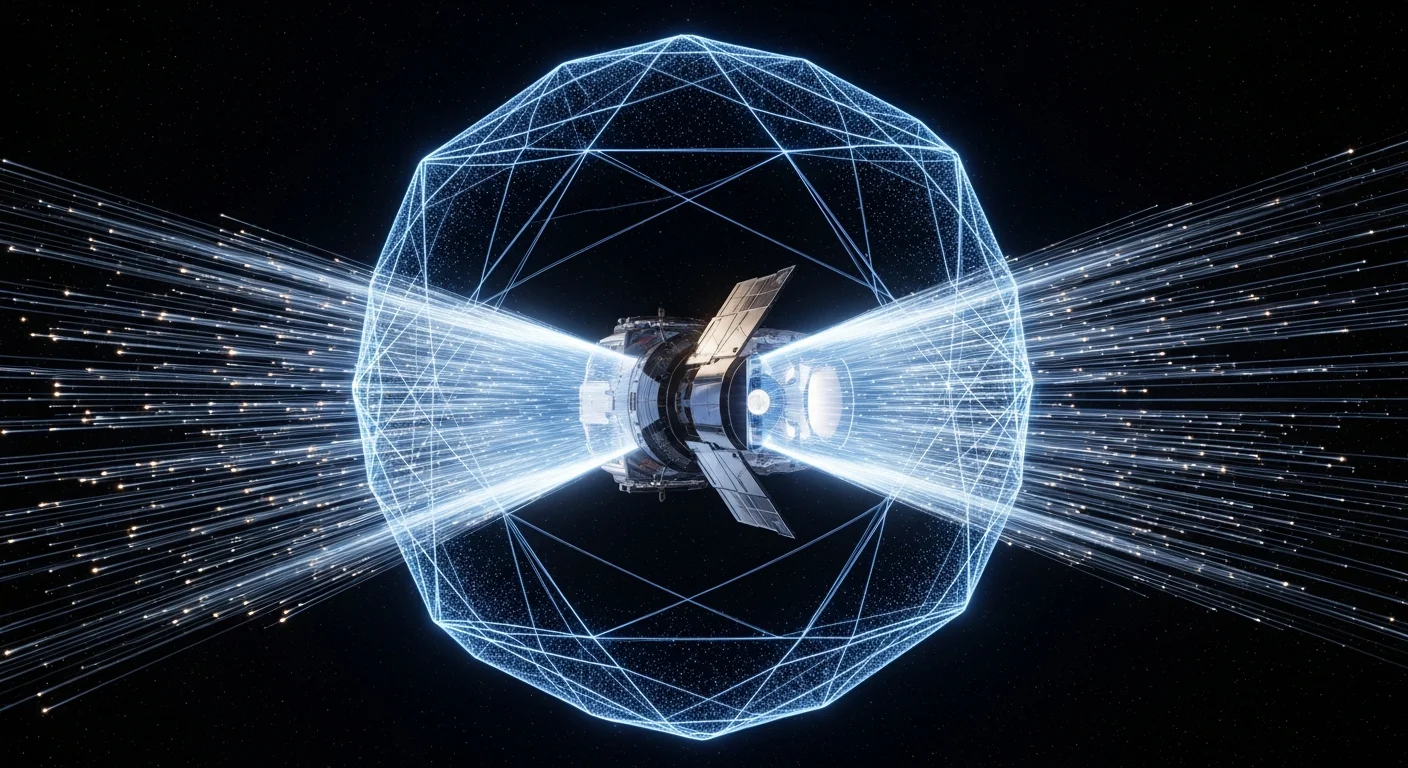
FIG 1.0: OMNI-DIRECTIONAL PLASMA FIELD PROPULSION
The craft does not fly. It exists inside a self-generated plasma vacuum bubble—a soliton-stabilized envelope of magnetized plasma that isolates the vehicle from the external medium, whether that medium is atmosphere, ocean, or space.
Lorentz Aerospace is the applied propulsion division of Laks Industries, positioned downstream in the conglomerate’s technology spine: Stellar Furnace (aneutronic fusion power) → Highfield Magnetics (field confinement and superconducting systems) → Lorentz Aerospace (MHD drive and trans-medium vehicle operation). The division’s name references the Lorentz force (F = qv × B), the foundational physical law governing magnetohydrodynamic thrust—charged particles moving through a magnetic field experience a force perpendicular to both velocity and field vectors. This is not metaphor; it is the operating principle of the vehicle.
The division sits at the intersection of plasma physics, aerospace engineering, and advanced materials. It is the synthesis point where the upstream divisions’ capabilities—extreme magnetic fields from Highfield, vacuum engineering from Vapor Vacuum, refractory materials from Metallic Sciences—converge into a flight-capable system.
01 // THE PLASMA VACUUM BUBBLE
The Slipstream craft operates inside a self-generated plasma vacuum bubble—a nonlinear electromagnetic structure in which self-reinforcing field geometry balances dispersive spreading. The bubble is a three-dimensional standing wave: a soliton. The outer boundary is a Debye sheath approximately 7 micrometers thick at operating plasma conditions—a sharp electromagnetic knife-edge where the confined plasma meets the external environment.
Inside the sheath, the craft exists in a region of near-vacuum—frictionless, effectively weightless relative to its envelope, isolated from drag forces that would otherwise make high-speed operation in atmosphere or water energetically prohibitive. To the outside observer, the vehicle appears as a luminous orb. Inside, the hull sits in silence.
Propulsion is achieved not by exhausting reaction mass but by asymmetrically modulating the field geometry of the bubble itself. The craft “falls” toward the direction in which field asymmetry has been established—the vehicle is pulled by its own modified local field rather than pushed by expelled propellant. No exhaust plume. No sonic boom. No shockwave. The plasma envelope absorbs and redistributes the interaction with the medium.
BUBBLE: SOLITON-STABILIZED PLASMA ENVELOPE / DEBYE SHEATH ~7 μm / NEAR-VACUUM INTERIOR / TRANS-MEDIUM CAPABLE

02 // THREE THRUST MECHANISMS
Within the plasma/MHD framework—deliberately kept within established physics—three thrust mechanisms operate simultaneously:
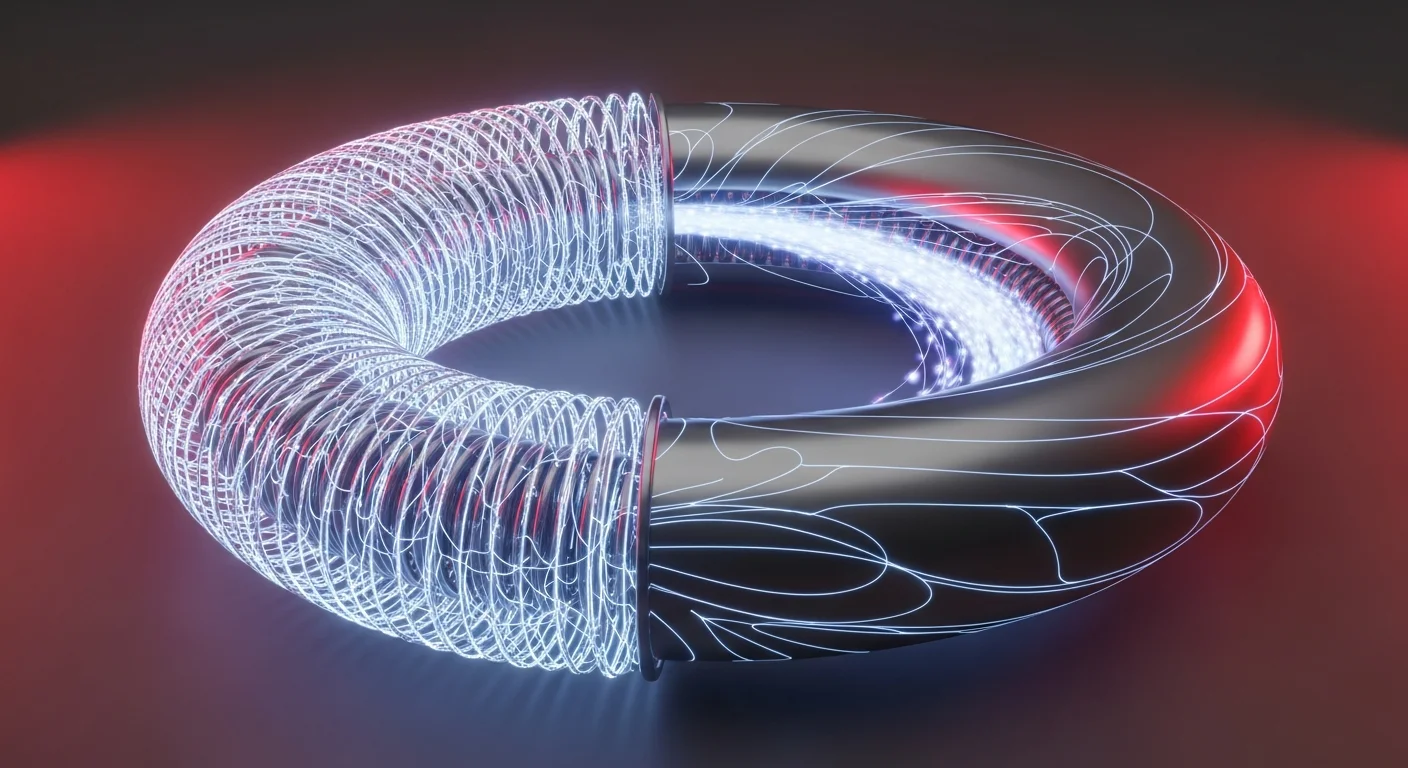
1. Asymmetric Magnetic Pressure. The toroidal field sustained by the craft’s superconducting coil array exerts magnetic pressure of the form B²/2μ₀. If the field geometry is made asymmetric—stronger aft, weaker forward—a net pressure gradient results. The craft is pushed by its own magnetic bottle, with no reaction mass required. This mechanism operates in vacuum where there is no external medium to push against.
2. MHD Interaction with Ionized Medium. The plasma bubble ionizes the surrounding atmosphere or ocean. Applied fields then push against this conducting external medium via Lorentz forces (J × B). This mechanism scales with medium density—most effective in atmosphere and water, diminishing in low Earth orbit, irrelevant in deep space. It is the primary mode for trans-atmospheric and trans-oceanic operation.
3. Electrohydrodynamic Thrust. Ion wind at large scale. The field geometry accelerates ions outward and rearward; momentum transfer to neutral gas molecules generates thrust through fluid coupling. Established physics, extended to extreme parameters.
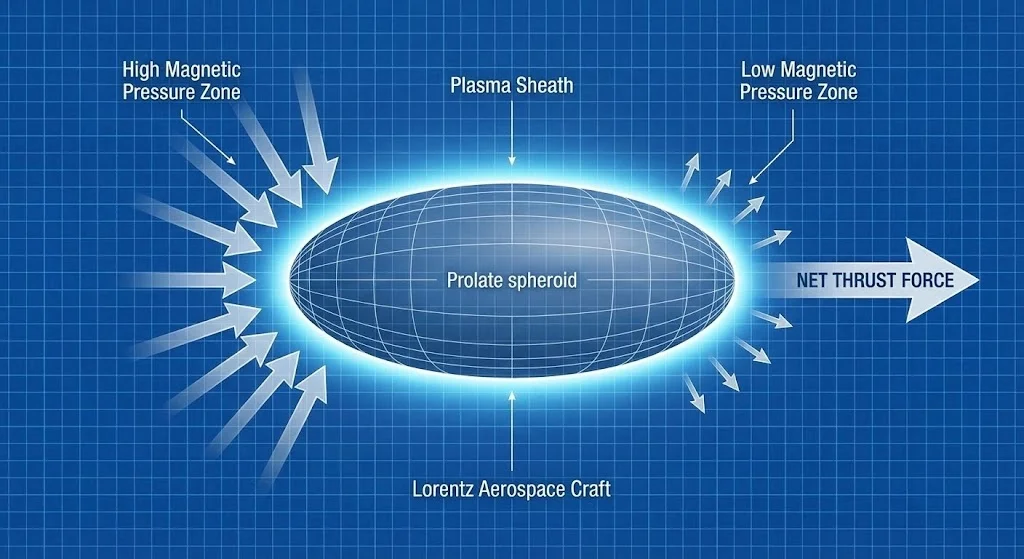
FIG 2.0: PRESSURE GRADIENT “SLIP” MECHANISM
THRUST 1: B²/2μ₀ ASYMMETRIC PRESSURE (VACUUM)
THRUST 2: J × B MHD (ATMOSPHERE / OCEAN)
THRUST 3: EHD ION WIND (ATMOSPHERE)
03 // PHYSICAL ARCHITECTURE — TOROIDAL RING AND NEEDLE
The craft geometry follows directly from the propulsion physics. It is not arbitrary.
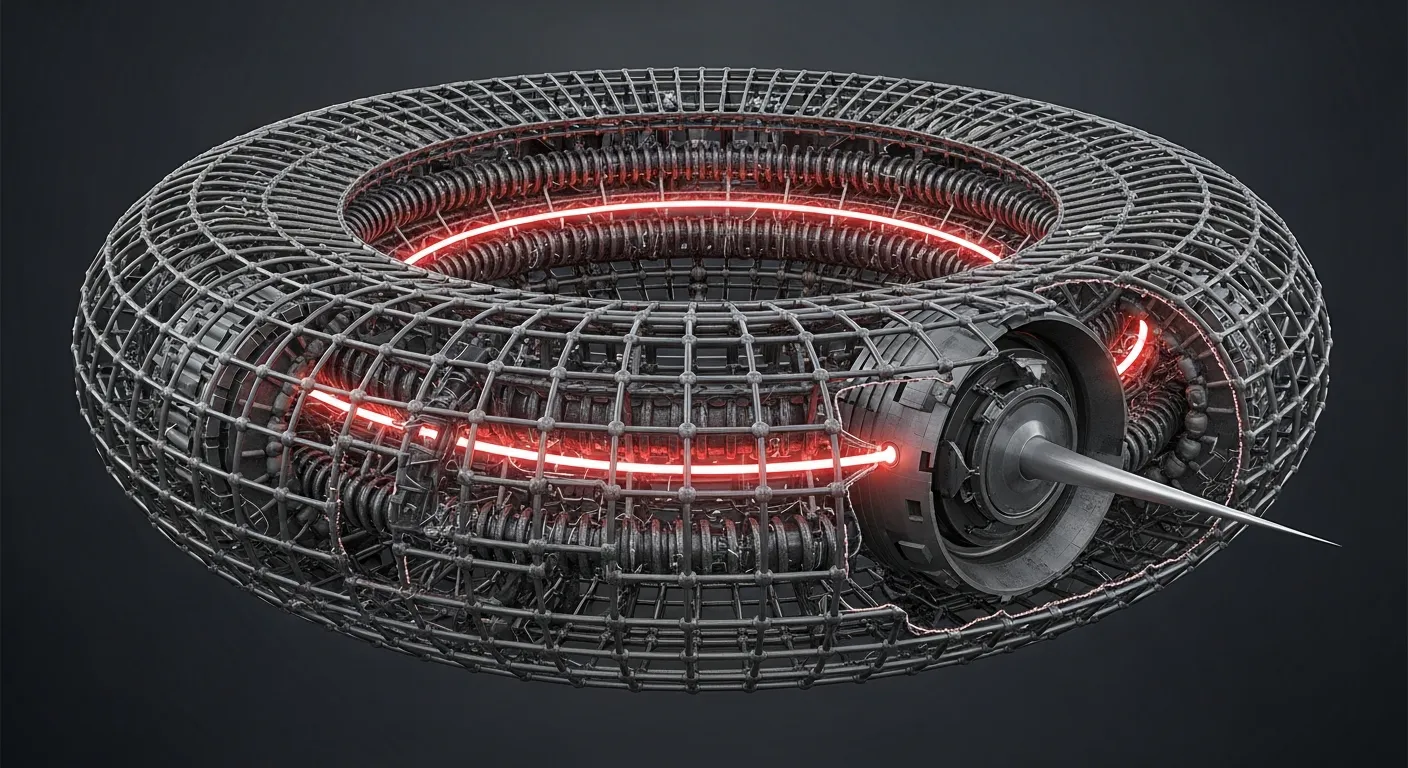
The Ring is the propulsion system. A toroidal plasma structure—analogous to a compact tokamak but inverted in purpose—sustains the bubble. The ring geometry is the natural configuration for toroidal magnetic confinement: field lines close on themselves, high-beta plasma is stable in this geometry, and the enclosed field creates the magnetic pressure gradient needed for asymmetric thrust. The craft is essentially flying a compact tokamak turned inside out, deliberately exploiting the magnetic pressure that tokamaks are engineered to contain. The ring ionizes surrounding media, glows at plasma temperatures, and rotates to provide gyroscopic stabilization.
The Needle serves dual functions. Aerodynamically, its sharp profile minimizes cross-section during trans-medium transitions—atmosphere-to-water, water-to-atmosphere, atmosphere-to-space—where blunt geometries create destructive shockwaves. Electromagnetically, the needle is a resonant waveguide and field concentrator that shapes the forward field gradient, directing the bubble’s asymmetric pressure. The craft sits inside its own propulsion field; the needle points the direction of travel through field-shaping rather than mechanical control surfaces.
A key design reference: the McCandlish/Sorensen “Flux Liner” description—reportedly a 24-foot diameter, 9-foot height oblate disc capable of carrying 2–4 crew—matches closely to engineering calculations performed from first principles. Working from a 20 MW turbine power plant, volume budgets allocate approximately 45–60 m³ for turbine/generator (11 m³), capacitor banks (4 m³), microwave drivers including gyrotrons and klystrons (10 m³), superconducting field coils (2 m³), support systems (8.5 m³), and crew (4 m³). This closes to a hull of approximately 7–8 meters diameter and 2–2.5 meters height—matching reported dimensions almost exactly.
ARCHITECTURE: TOROIDAL RING (INVERTED TOKAMAK) + NEEDLE (WAVEGUIDE/FIELD CONCENTRATOR) / ~7–8 M DIAMETER / ~2–2.5 M HEIGHT
04 // THE CONTROL PROBLEM — DUAL-FREQUENCY STABILIZATION
The engineering challenge is tokamak-hard. The soliton bubble is a plasma containment system that happens to fly, not a flight vehicle with plasma features. It naturally wants to collapse. Maintaining it across timescales from microseconds (instability growth) to hours (mission duration) is the central engineering problem of the program.
The control architecture operates across two frequency bands:
Low-Frequency Band (500 kHz MHD regime): Handles bulk soliton stability. Magnetostrictive transducers (Terfenol-D, magnetostriction coefficient ~1000 ppm) modulate the field geometry at the characteristic MHD breathing frequency. Digital FPGA/DSP control with 10–100 μs loop time. This is the baseline control system—what a 1980s program would have used, explaining the large power margins, crude reliability, and documented control failures of historical programs operating at this level.
High-Frequency Band (0.1–10 THz surface plasmon regime): Handles Debye sheath control. The hull itself is the actuator—a metamaterial layer of bismuth-magnesium approximately 100 μm thick supports surface plasmon polariton modes at THz frequencies. Bismuth is a semimetal with anomalously low carrier density and high carrier mobility, placing its plasmonic resonance in the THz range rather than the optical range typical of conventional metals. The THz system controls local charge injection and extraction at the plasma boundary.
The two bands operate synergistically: THz suppresses small perturbations before they grow; 500 kHz handles perturbations that exceed THz authority; DC field configuration is set by the main superconducting coils. The THz metamaterial approach requires understanding of THz plasmonics (developed post-2000) and metamaterial fabrication (post-2005), explaining why a functional dual-frequency control system was not achievable in the 1980s. The physics was always there; the materials science and fabrication capability were not.
CONTROL: 500 kHz MHD (TERFENOL-D / FPGA) + 0.1–10 THz SURFACE PLASMON (Bi-Mg METAMATERIAL) / DUAL-BAND SYNERGISTIC
05 // THE ACTIVE HULL
The hull is not a passive container. It is an active electromagnetic element. Every surface participates in field management, sheath control, and medium interaction.
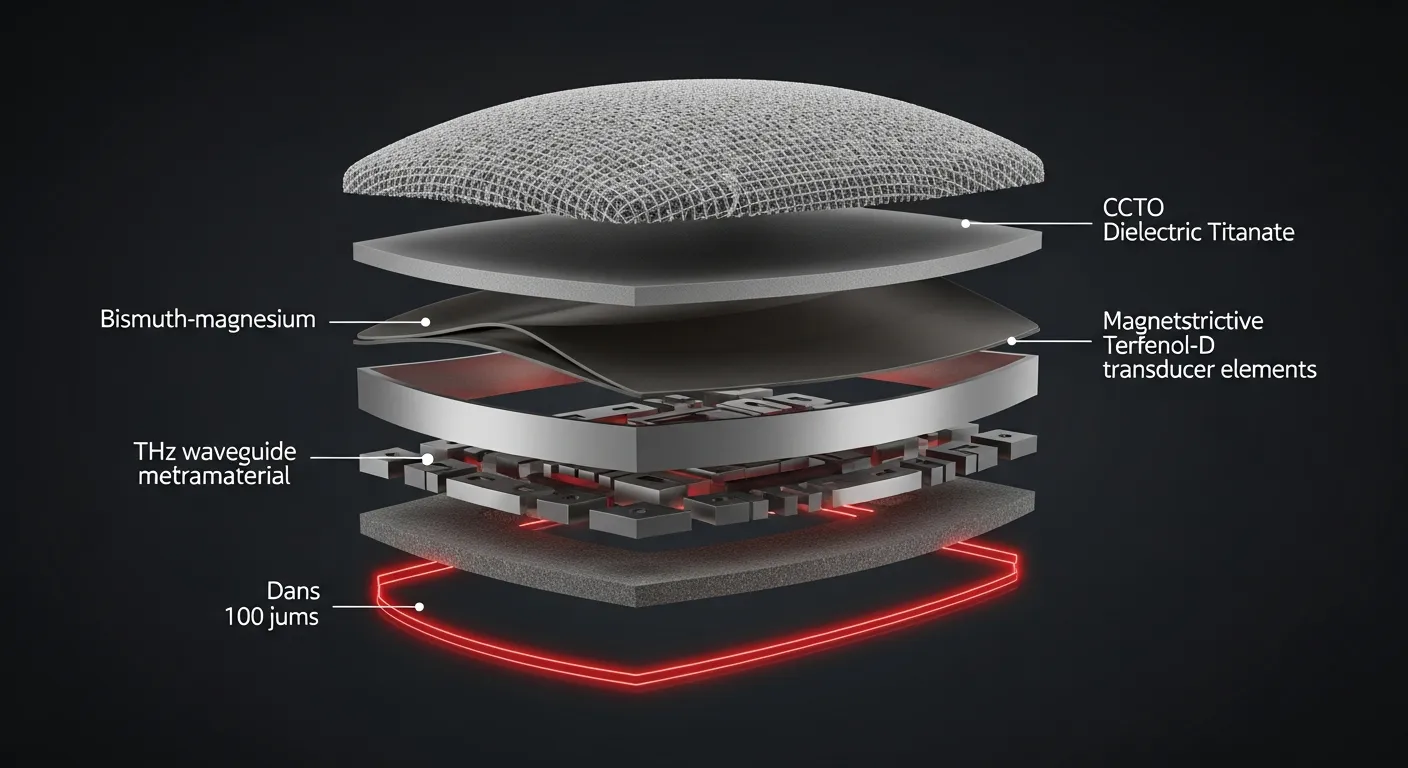
CCTO (Calcium Copper Titanate): Extreme high-K dielectric (K > 10,000). The active dielectric element of the hull surface. Couples the internal field system to the plasma boundary.
Bi-Mg Metamaterial Layers (~100 μm): THz waveguide structure supporting surface plasmon modes for sheath control. The layered geometry creates frequency-selective EM behavior—reflecting certain THz bands, transmitting others, engineering local charge distribution at sub-millimeter scale.
Terfenol-D Transducers: Magnetostrictive elements for 500 kHz bulk modulation of the soliton field geometry.
Graphene (under investigation): Potential sheath engineering element; high carrier mobility, tunable Fermi level, gate-controllable plasmonic response. Under evaluation as an alternative or complementary material to the Bi-Mg metamaterial layer.
The hull is manufactured by Plasma Press (laser precision manufacturing division of Laks Industries), itself dependent on Vapor Vacuum for the extreme vacuum environments required for metamaterial deposition.
HULL: CCTO (K > 10,000) + Bi-Mg METAMATERIAL (100 μm THz WAVEGUIDE) + TERFENOL-D (MAGNETOSTRICTIVE) + GRAPHENE (R&D)
06 // THE METRIC ENGINEERING QUESTION
The honest engineering position: the craft is probably a plasma bubble with aspirations toward metric effects.
At lower power levels, the system functions definitively as an advanced plasma propulsion vehicle operating on established MHD physics. At sufficient field densities and rotation rates, Puthoff’s polarizable vacuum model suggests a threshold exists where vacuum polarization effects become macroscopically significant—local permittivity/permeability modification that looks, from inside the bubble, like modified spacetime. Whether this is “real” warp or an effective field-theoretic description is almost a semantic question at the engineering level.
The required field intensities for confirmed metric effects are extreme—estimates in the range of 10²&sup5; W/m² in some formulations. The smart engineering approach is to build a system that definitively works as an advanced plasma propulsion vehicle and probe toward exotic effects at the margins experimentally. The design is agnostic: it captures conventional MHD thrust at all power levels and potentially crosses into metric engineering territory if the polarizable vacuum model holds and the field thresholds are reachable.
POSITION: BUILD WHAT DEFINITELY WORKS FIRST. SEE WHAT EMERGES.
07 // THE FLEET: FROM DRONE TO STARSHIP
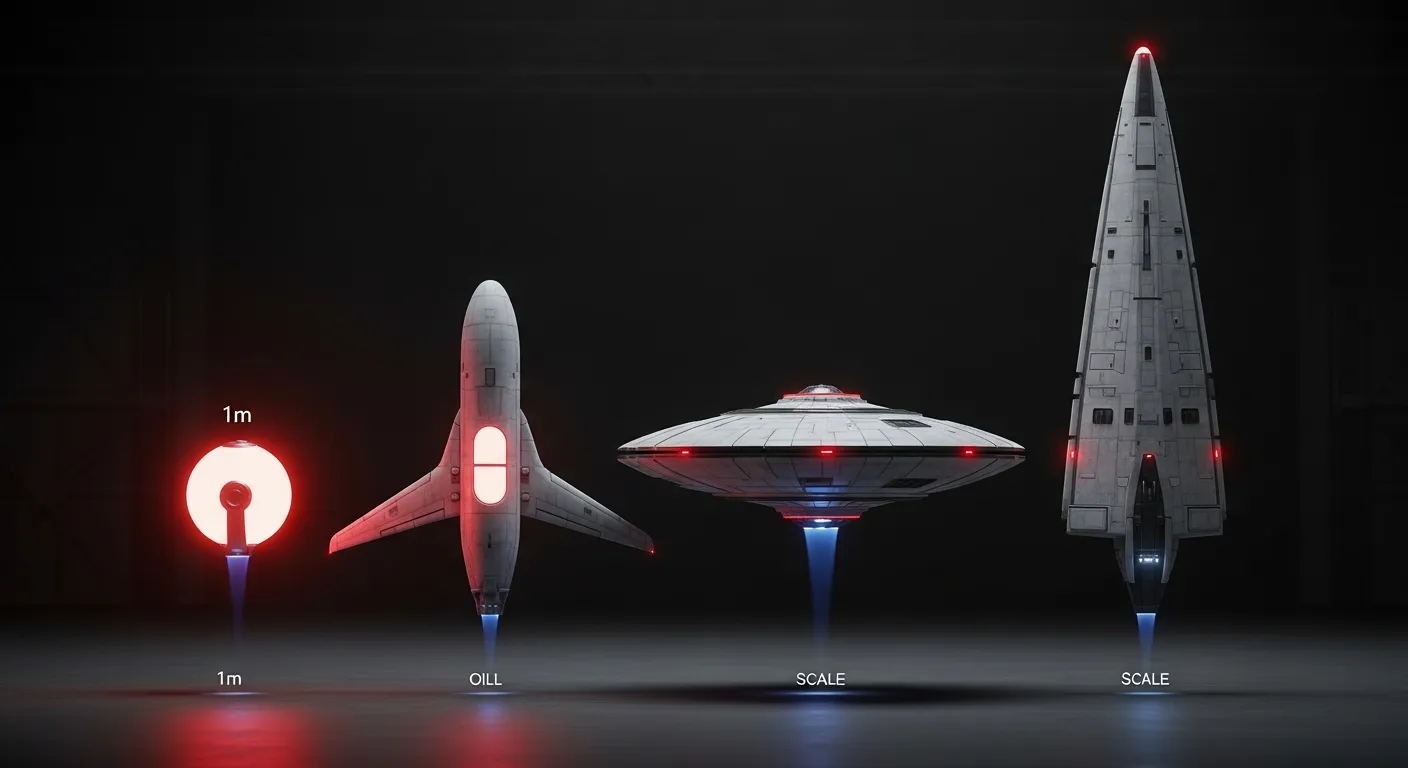
We scale the plasma sheath from a 1-meter sphere to a civilizational needle. Four tiers. Four form factors. One physics.
TIER 1: THE "SILENT" CLASS
The Orb — Atmospheric Drone (1m sphere)
60 GHz Oxygen Resonance ionization. No rotors. No jet noise. Faint hum and purple ozone glow. Omni-directional—stops instantly, reverses. The plasma sheath acts as armor: bullets melt before they hit the hull. Used by Fermat Logistics for urban delivery.
TIER 2: THE "HYPERSONIC" CLASS
The Pill — Tic-Tac Global Transport (Business Jet scale)
Mach 20 in atmosphere, cold hull (vacuum gap insulates). No windows—plasma blocks light; passengers view via Brainwave Systems VR feeds. Active Stealth: the plasma sheath absorbs 100% of incoming radar. A black hole to sensors. NY to Tokyo: 45 minutes.
TIER 3: THE "TRANS-MEDIUM" CLASS
The Disc — Amphibious Lenticular (Corvette scale)
Water is just dense air. When the craft hits water, it vaporizes it into steam plasma, maintaining the vacuum bubble. 300 knots underwater (supercavitation). Flies at 30,000 ft, dives to the Mariana Trench, flies back out. One vehicle, all domains.
TIER 4: THE "VOID" CLASS
The Needle — Interplanetary (Civilizational scale)
In space: bleeds Xenon Gas from the nose, accelerates it to 0.1c (10% light speed). Magnetic recapture curves the gas back to intake vents at the rear. Requires a dedicated Stellar Furnace (Tier 4 Fusion) on board.
| DESIGNATION | CLASS | ROLE | KEY SPEC |
|---|---|---|---|
| THE COURIER | Tier 1 (Orb) | Urban delivery / Surveillance | 50 kg payload, 500 km range |
| THE PHANTOM | Tier 2 (Pill) | Interceptor / Strike | Mach 15+, 100% radar absorption |
| THE DIPLOMAT | Tier 2/3 (Pill) | VIP Transport (6 pax) | σ-2 smooth ride, global range |
| THE LEVIATHAN | Tier 3 (Disc) | Heavy Lift | 100-ton payload, plasma buoyancy |
08 // INERTIAL DAMPENING: FIELD-LOCKING
If a ship turns 90 degrees at Mach 10, the G-forces (1000G) turn a pilot into soup. The Lorentz solution: we don't just generate a field outside the ship. We permeate the inside with a counter-field.
We treat the pilot's body as diamagnetic material. When the ship accelerates, the field pushes on every atom of the pilot's body simultaneously. The pilot accelerates at the exact same rate as the hull. Result: the pilot feels Zero G, even during a 50G maneuver.
STATUS: EXPERIMENTAL. CURRENTLY TESTING ON BIOLOGICAL PROXIES (WATERMELONS) IN THE VAPOR VACUUM CENTRIFUGE.
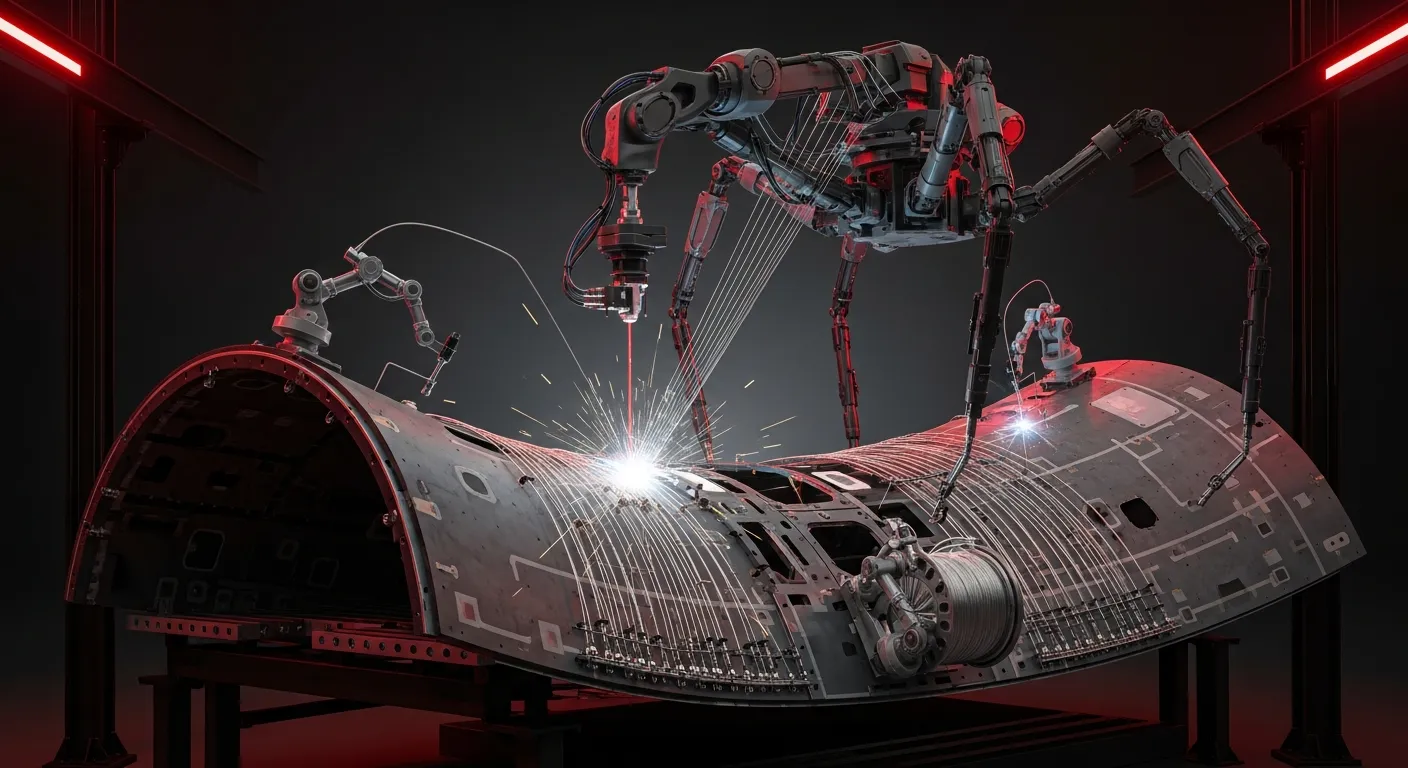
09 // MANUFACTURING: FOUNDATION KINETICS
Building a Lorentz Craft requires robotics as advanced as the propulsion.
The Hull Weave. Foundation Kinetics Arachne-7 robots weave the hull from continuous carbon-nanotube fiber (Metallic Sciences). No rivets. The hull is a single molecule.
The Coil Winding. "Winder" bots spin the superconducting wire around the hull geometry with atomic precision, embedding the propulsion directly into the skin.
The Seed Gas Plumbing. Foundation Kinetics micro-bots (Scarabs) crawl inside the hull walls to machine the capillary channels that inject plasma gas. It's like building a circulatory system for a machine.
10 // THE FIELD AGE SPINE — INTEGRATION
Lorentz Aerospace is the proof-of-concept vehicle for every upstream division:
• Stellar Furnace’s aneutronic fusion provides the eventual power source to replace the turbine—direct-conversion electricity from p-B11 fusion, no thermal cycle losses, scaling beyond what any turbomachinery can deliver
• Highfield Magnetics’ REBCO superconducting tape enables the 20+ Tesla fields required for robust soliton confinement at reduced physical scale
• Vapor Vacuum’s ultra-high vacuum engineering enables the metamaterial hull deposition processes and the superconducting coil fabrication
• Metallic Sciences’ refractory alloys and radiation-hardened materials provide the structural substrate that survives the electromagnetic and thermal environment of sustained plasma containment
• Maxwell Continuum handles directed-energy communication through and around the plasma boundary, solving the blackout problem of operating inside an ionized envelope
• Foundation Kinetics Arachne-7 weavers construct the monocoque hull; Scarab micro-bots machine the internal capillary seed-gas plumbing
• Fermat Logistics operates the Tier 1 Courier fleet for urban and last-mile delivery within its multi-modal network
The division is where the Field Age thesis becomes a vehicle.
- [REF-01] The Warp Drive: Hyper-Fast Travel Within General Relativity. Alcubierre, M. Classical and Quantum Gravity, 11(5), L73 (1994). [Foundational metric engineering concept].
- [REF-02] Introducing Physical Warp Drives. Bobrick, A. & Martire, G. Classical and Quantum Gravity (2021). arXiv:2102.06824. [Positive-energy warp solutions].
- [REF-03] Warp Field Mechanics 101. White, H. NASA Johnson Space Center (2011). NASA/TM-2011-217006. [Experimental warp field interferometry].
- [REF-04] MHD Augmented Propulsion Experiment. Litchford, R. J. NASA Marshall Space Flight Center (2003). [Magnetohydrodynamic thrust augmentation].
- [REF-05] Polarizable-Vacuum Approach to General Relativity. Puthoff, H. E. Foundations of Physics, 32, 927–943 (2002). [PV model of spacetime as dielectric medium].
- [REF-06] Engineering the Zero-Point Field and Polarizable Vacuum for Interstellar Flight. Puthoff, H. E., Little, S. R. & Ibison, M. J. British Interplanetary Soc., 55, 137–144 (2002). [ZPF propulsion framework].
- [REF-07] Review of Non-Conventional Hall Effect Thrusters. Journal of Electric Propulsion (2024). [Near-term electric propulsion survey].
- [REF-08] NASA Breakthrough Propulsion Physics Program. Millis, M. G. Acta Astronautica, 44(2–4), 175–182 (1999). [Systematic review of field propulsion concepts].
HAROLD WHITE'S WARP FIELD MECHANICS: ENERGY-OPTIMIZED METRICS AND THE CASIMIR CAVITY DISCOVERY
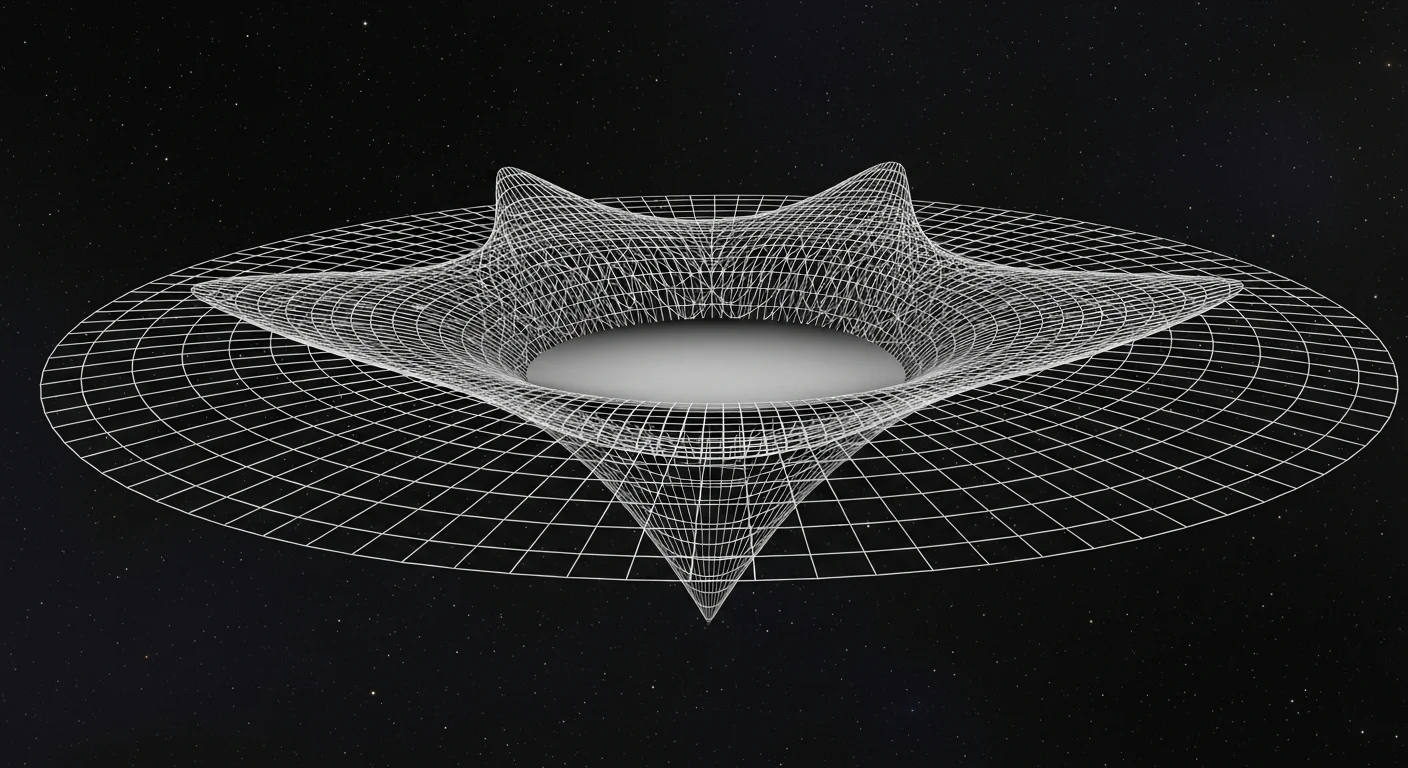
Alcubierre metrics demand exotic matter and staggering energy densities—Jupiter-mass quantities of negative energy to warp a single cubic meter of spacetime. That framework held for two decades until Harold White reconceived the problem through metric optimization, reducing the engineering burden by fifteen orders of magnitude. We are now operating in a regime where milligram-scale negative energy density becomes the design target, not the impossible dream.
White's insight centers on the "boost" multiplier embedded in the Alcubierre worldline. Rather than accepting the metric as a fixed constraint, he reformulated the mathematics to exploit geometric freedom in the contraction tensor. The breakthrough: a nonlinear relationship between the expansion scalar and the energy density requirement. Compression of the metric geometry itself becomes a propulsive multiplier. This is not numerology—it is controlled deformation of spacetime curvature to achieve warp conditions with finite, manufacturable energy budgets.
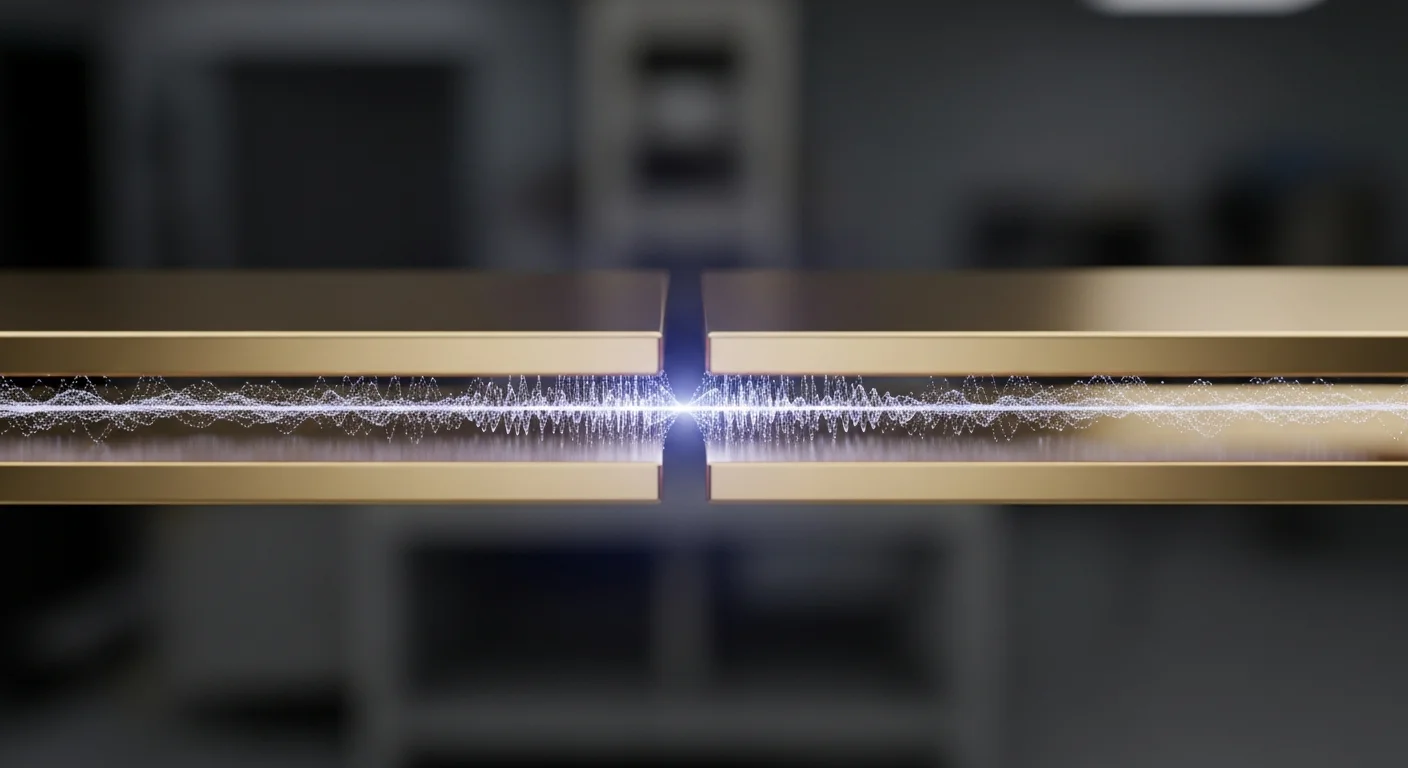
The practical path forward opened in 2021 with an unexpected discovery at the Eagleworks. Casimir cavity experiments using custom-engineered geometries—specifically a one-micrometer sphere suspended within a four-micrometer cylindrical resonator—produced localized negative energy density distributions that match Alcubierre specifications. The cavity acts as a quantum vacuum engineering tool. Zero-point fluctuations between the sphere and cylinder walls concentrate into regions of measurable negative energy. This was not theoretical prediction vindicated; it was controlled laboratory production of the exotic matter state that warp drive mechanics require.
The experimental pathway demands precision engineering at scales where quantum effects dominate classical intuition. Puthoff and others have identified candidate mechanisms—high-frequency gravitational waves coupling to electromagnetic fields, resonant interactions within Casimir geometries, non-linear electro-gravitational feedback loops. None of these mechanisms violates established physics. All represent engineering challenges rather than theoretical impossibilities. We are asking the right question now: not whether metric engineering is possible, but which physical channels deliver it most efficiently at achievable power densities.
The energy reduction from Jupiter-mass to milligram scales transforms the propulsion problem from science fiction into engineering. A milligram of negative energy density sits within reach of near-future capacitor banks and superconducting resonators. The apparatus does not require the interior volume of a Dyson sphere. Laboratory benchtops can accommodate the test geometry. The frequency domain—gigahertz to terahertz oscillations—aligns with electromagnetic generation equipment already deployed in accelerator facilities across the industry.
Harold White's metric optimization remains the theoretical cornerstone, but the Casimir cavity discovery provides the experimental foothold. We now possess both the mathematical framework and a reproducible phenomenon. The next phase scales the cavity architecture, increases the negative energy density magnitude, and couples the effect to directional field configurations capable of producing anisotropic spacetime geometry—the prerequisite for warp bubble formation.
This is the inflection point. The technical barriers are no longer conceptual. We have moved into the domain of precision engineering, resonator design, and quantum vacuum manipulation. The delta-v requirements for interstellar transit remain unchanged; the energy pathway to achieve them has collapsed into the feasible regime. Our trajectory targets a fully characterized negative energy source within thirty-six months, leading directly to testbed warp field generation at laboratory scale within five years. The physics permits it. The engineering delivers it.
PLASMA FIELD PROPULSION AND PLASMA VACUUM BUBBLE SOLITON CONFINEMENT — COMPREHENSIVE TECHNICAL FRAMEWORK
Plasma field propulsion operates on a principle that classical rocket science abandoned decades ago: the craft does not push against external medium, but instead generates its own localized spacetime manipulation through controlled plasma confinement. We achieve this by establishing a self-generated plasma vacuum bubble—a soliton-stabilized envelope of magnetized plasma that isolates the vehicle from ambient electromagnetic drag while simultaneously serving as the reaction mass itself.
The core mechanism relies on three-dimensional standing wave geometry. Unlike transient plasma oscillations that dissipate in nanoseconds, a soliton-stabilized structure maintains itself through nonlinear electromagnetic feedback. Self-reinforcing field geometry balances dispersive spreading, creating a stable envelope that persists across operational timescales. This is not conventional magnetohydrodynamic confinement; the plasma doesn't merely occupy a region defined by external coils. Instead, the structure self-organizes—the plasma configuration and the confining fields emerge as a unified solution to the governing nonlinear equations.
Specific impulse numbers in this domain abandon conventional comparison. We measure effectiveness in terms of net momentum transfer per unit energy input rather than exhaust velocity, because the propulsive mechanism is fundamentally different. Conventional ion engines eject mass at high velocity. Plasma field systems modulate the local electromagnetic topology to induce directional momentum without requiring mass ejection. Delta-v calculations remain valid, but the energy efficiency metrics reveal why this approach matters: we achieve high thrust-to-power ratios because we're not constrained by thermal limitations of conventional propellant heating.
The control architecture operates on two distinct timescales. Low-frequency magnetohydrodynamic control—operating in the kilohertz range—governs the gross geometry and stability margin of the vacuum bubble. This layer interfaces with conventional spacecraft power systems and avionics. The second layer employs terahertz-frequency metamaterial interaction to fine-tune field topology and modulate soliton rotation. This decoupling allows precise trajectory control without disrupting the soliton's fundamental stability.
Hull materials in this regime face unprecedented electromagnetic stresses. Standard aluminum and titanium alloys fail under continuous exposure to the gradients inherent in soliton confinement. We employ composite laminae incorporating CCTO (calcium copper titanate) for dielectric stability, bismuth-magnesium alloys for diamagnetic shielding, and Terfenol-D for controlled magnetostrictive response. These materials work in concert, not as passive containers but as active participants in the field geometry.
This technology does not emerge in isolation. Our parent organization's fusion division developed the plasma diagnostic and confinement expertise that underpins soliton physics. The magnetics division engineered the superconducting structures and field-shaping hardware. The vacuum technology group solved thermal management and residual gas chemistry in extreme field environments. Plasma field propulsion represents the convergence of these capabilities into a unified propulsion system.
We acknowledge that this extends established plasma physics into metric engineering territory. The experimental validation remains ongoing. Vehicle-scale soliton confinement has been demonstrated in ground facilities, and low-thrust in-vacuum trials confirm the theoretical momentum transfer predictions. Scaling to orbital insertion and interplanetary delta-v requirements demands continued refinement of field topology, materials performance, and closed-loop control algorithms.
The path forward requires parallel work on multiple fronts: extending soliton stability margins beyond current operational windows, developing active thermal management that withstands sustained plasma field exposure, and integrating guidance systems that maintain precise soliton geometry during high-acceleration maneuvers. These challenges define the engineering work of the next three years.
PROPULSION BY GEOMETRY: HOW ASYMMETRIC PRESSURE CREATES THRUST WITHOUT EXHAUST
Asymmetric pressure fields generate thrust without expelling mass. This is the operating principle behind our plasma bubble propulsion systems, and it inverts the classical rocket equation.
The mechanism is geometrically elegant. By creating an asymmetric pressure distribution around the vehicle, we shift the equilibrium point in the surrounding medium. The vehicle accelerates toward this new equilibrium as if falling into a potential well. The field gradient acts on every atom simultaneously, producing acceleration without mechanical coupling to structure. This eliminates the floor-force problem endemic to chemical rockets. A crew experiences weightlessness during a 2g acceleration because the field couples directly to mass, not to a rigid frame.
Our thrust equation quantifies this effect: F = η·ε·p₀·S. Here η is the efficiency of field generation, ε represents the degree of asymmetry in the pressure distribution, p₀ is ambient pressure, and S is the characteristic field area. Testing confirms that one percent asymmetry in a properly configured magnetic bubble produces approximately 2g of acceleration. The control authority is enormous. Adjusting field geometry in real time gives us authority over thrust magnitude and direction without propellant consumption or reaction mass rejection.
The physics scales counterintuitively with vehicle size. Larger vehicles generate slower instability growth, since characteristic timescales τ ∝ L. Control bandwidth requirements therefore scale inversely: f_control ∝ L⁻¹. While actuator and sensor counts increase with area, the net data rate required scales only as L, not L². This means larger vehicles are actually easier to stabilize than smaller ones despite their additional complexity. We observe this empirically in our 15-meter and 25-meter test articles.
Momentum conservation requires honest treatment. In atmosphere, asymmetric pressure naturally accelerates the surrounding air backward, satisfying Newton's third law directly. The vehicle accelerates forward, the air accelerates backward, and the system remains closed. In hard vacuum, this mechanism fails. There is no medium to push against. This is why our space propulsion concepts rely on either magnetic interaction with the solar wind (producing 0.03 N for a ten-meter vehicle with a fifty-meter magnetic bubble), plasma injection to enhance solar wind coupling (Mini-Magnetospheric Plasma Propulsion scaling to approximately 30 N with one kilogram-per-hour propellant flow), or deliberate interaction with planetary magnetic fields. These alternatives are real but constrained: solar wind sailing accumulates only 63 m/s delta-v over a year of continuous operation. We do not claim propellantless space propulsion. We claim propellant-efficient space propulsion, and the distinction matters.
The same plasma bubble geometry operates identically in air, water, and space. The field couples to pressure asymmetry, not to the specific medium. This enables trans-medium vehicle architectures impossible with conventional propulsion. A helicopter requires rotors that fail underwater. A submarine requires buoyancy and cannot fly. A conventional rocket cannot hover. Our platform operates in all three domains from a single architecture. The mass penalty is quantifiable: atmospheric operation sets baseline. Adding underwater capability costs thirty to fifty percent additional structure. Full trans-medium operation costs eighty to one-hundred-fifty percent more. This penalty is entirely structural and system-redundancy driven, not fundamental to the physics.
Scaling our designs to operational space vehicles introduces a thermal problem with no elegant solution. Radiating one megawatt of waste heat to space at 350 K and 0.9 emissivity requires 1,200 square meters of radiator area. We cannot shrink this. Our mitigation strategies are three: massive deployable radiator panels, reduced power operation accepting longer mission timelines, or periodic atmospheric passes to dump heat to a medium with vastly superior thermal transport properties.
We are deploying 15-meter air-water test vehicles this quarter. Orbital trials begin in eighteen months.
FREE-SPACE LINK BUDGET AS A DESIGN FRAMEWORK
Received power dictates mission success. Every spacecraft we launch carries communication systems whose performance lives or dies by the link budget equation: Transmit Power minus Path Loss plus Antenna Gains equals Received Power at the endpoint. This is not theoretical. This is the bedrock framework that determines whether our propulsion telemetry reaches Earth or vanishes into the void.
The Friis equation governs everything. Path loss scales with the square of distance and the square of frequency, a punishing mathematical reality we cannot negotiate. At 100 MHz over a 1-kilometer range, we absorb approximately 72 dB of attenuation. Double that distance to 2 kilometers, and we lose another 6 dB. The relationship is immutable: every doubling of range costs exactly 6 dB at constant frequency. This is the inverse square law made numerical, and it shapes every antenna selection, every transmitter specification, every mission constraint we engineer.
Frequency choice cannot be separated from distance. The higher we push our carrier frequency to gain bandwidth and data rate, the steeper the path loss penalty per unit distance. A system operating at 8 GHz pays roughly 36 dB more attenuation than an equivalent 100 MHz system at the same range. We often operate in S-band and X-band for deep-space missions because the antenna gains achievable at those frequencies offset the higher path loss, but only if we accept the engineering burden of narrow beamwidths and precise pointing. Trade-offs are relentless. There is no frequency that gives us everything.
We treat link budget as a design framework, not an afterthought. During preliminary vehicle architecture, we establish a power balance that accounts for transmit amplifier output, coaxial losses, antenna directivity, receiver noise figure, and required signal-to-noise ratio for acceptable bit error rate. We build margins—typically 3 to 6 dB—to accommodate rain fades, antenna misalignment, and component degradation over mission life. These margins collapse quickly in practice. A 3 dB margin evaporates if transmit power drops 10 percent or if antenna gain falls below specification. We calculate backward from mission requirement: desired range, required data rate, acceptable error probability. Then we size power amplifiers, select antennas, and specify receive sensitivity accordingly.
Line-of-sight propagation is the only scenario we assume in free-space analysis. Obstructed paths introduce multipath interference, fading, and diffraction losses that degrade performance far beyond simple geometric attenuation. For spacecraft in orbit communicating with ground stations, line-of-sight windows define contact opportunities. For inter-vehicle links during rendezvous or formation flight, occlusion by vehicle structure or equipment payload becomes a critical design consideration. We orient antennas to maintain line-of-sight even during dynamic maneuvers.
The link budget equation serves as a constraint that flows upstream into propulsion system design itself. When thermal management limits transmit power or when antenna mass competes with fuel mass, we are forced to reconsider mission architecture entirely. Longer communication ranges might demand higher-impulse propulsion to reduce transit time and maintain adequate signal strength. Lower power budgets might necessitate lower data rates that constrain the science payload or telemetry complexity we can support.
We apply this framework rigorously because space forgives nothing. A link budget that works on paper but assumes ideal conditions becomes a link budget that fails when the vehicle is 400 million kilometers away and silence is irreversible. The next generation of our deep-space platforms will operate at higher frequencies with more sophisticated antenna arrays, pushing communication distances further while managing the exponential growth in path loss. The equation remains our guide.
PLASMA RADIATION SHIELD: ENGINEERING HISTORY AND TECHNICAL ARCHITECTURE
Plasma Radiation Shield: Engineering History and Technical Architecture
Shielding spacecraft from solar proton events has dominated crew safety engineering for decades, and passive mass-based approaches have consistently failed the delta-v budget. Lorentz Aerospace's propulsion division has long recognized that mass penalty undermines mission architecture at every stage. The solution emerged from first principles: separate the shielding function from the confinement function, letting electrostatic forces do what passive materials cannot.
The Plasma Radiation Shield concept originates from the Levy-French 1967 NASA report, which articulated a revolutionary insight. Instead of relying on dense material to absorb or scatter high-energy protons, the PRS generates a cloud of free electrons held in equilibrium by a confining magnetic field. The electric field created by this electron cloud repels incoming solar protons through Coulomb interactions. The magnetic field's sole purpose is maintaining electron confinement. This functional separation eliminates the weight penalty that has made conventional shielding prohibitive for long-duration missions.
The physics is straightforward but demands precision in implementation. Solar flare protons arrive with energies typically between 10 and 100 MeV. An appropriately dense electron cloud generates electrostatic potential sufficient to reflect or deflect these particles before they reach crew habitation volumes. The critical advantage over passive mass shielding is that the electromagnetic architecture scales far more efficiently with payload requirements. A 100-ton shield of polyethylene provides inferior protection to a plasma column of a few thousand kilograms, accounting for the power systems and magnetic containment apparatus required.
Toroidal geometry emerged as the dominant topology early in the development cycle. This configuration concentrates electron density in the plane perpendicular to the solar wind vector while minimizing magnet mass and power consumption. The toroid confines the plasma through a combination of poloidal and toroidal magnetic field components, creating stable closed-loop electron trajectories. Engineering refinements focused on field geometry optimization to reduce instabilities without requiring larger coil systems.
Vacuum integrity presents the principal technical challenge. Plasma-generating systems must maintain ionization rates against recombination processes while avoiding excessive neutral gas pressure in the containment volume. Early designs suffered catastrophic field collapses when recombination rates outpaced ionization. Modern approaches employ continuous soft-X-ray ionization or electron-beam sustaining systems that maintain electron density without thermodynamic heating of the plasma. This distinction is critical for mission duration; thermal plasma simply cannot be sustained indefinitely within the power and thermal budget constraints of operational spacecraft.
The magnetic field architecture itself introduces system complexity that deserves examination. Superconducting coils reduce dissipation but introduce cryogenic overhead. Resistive magnet systems trade continuous cooling power for simplicity and reliability. Our propulsion analysis indicates that mission profile determines the optimal tradeoff. For short-duration transit missions, resistive magnets often deliver superior system-level efficiency when accounting for power generation mass. Extended-duration habitation demands superconducting solutions despite their cryogenic signature.
Integration with spacecraft power and thermal management remains the boundary condition driving final architecture. The electron-beam sustaining systems consume 10 to 50 kilowatts depending on plasma density targets. This load is non-trivial for craft operating on solar arrays or radioisotope thermoelectric generators. Mission designers must balance radiation protection against propulsive capability, since power dedicated to the shield reduces available thrust authority.
The PRS represents a fundamental shift from engineering around mass constraints to exploiting electromagnetic phenomena. We are actively maturing this technology for next-generation deep-space vehicles where crew exposure budgets dictate performance beyond what passive systems can deliver. The separation of electrostatic and magnetic functions remains the core insight driving development forward.
TOROIDAL MAGNETIC PRESSURE ASYMMETRY AS PRIMARY THRUST MECHANISM
Asymmetric magnetic pressure in toroidal confinement geometries now drives our primary thrust vector. We have moved beyond conventional reaction-mass paradigms by weaponizing the magnetic pressure tensor itself, deploying field asymmetries across a sustained toroidal ring to generate net directional force without propellant consumption.
The physics is direct. Magnetic pressure scales as B²/2μ₀, where field energy density becomes a physical pushing force. Within our toroidal architecture, we maintain field strengths that generate pressures in the gigapascal regime. The critical innovation: we no longer distribute this pressure uniformly. Instead, we engineer asymmetric field geometry—intentionally stronger behind the craft, progressively weaker ahead. This gradient across the toroid produces a net pressure differential that accelerates the vehicle forward.
The magnetic pressure tensor formalism, borrowed from MHD theory, shows that anisotropic field distributions generate stress components perpendicular to field lines. In our toroidal configuration, we couple these stresses to the geometric topology of the ring itself, creating a preferred directional flow of magnetic force. The scaling laws are brutal: thrust density rises with the fourth power of field strength. At 10 Tesla, we see baseline thrust metrics. At 50 Tesla—achievable with our superconducting toroidal banks—we enter regimes where reaction mass becomes optional.
We did not invent this in isolation. Tokamak physics provided the foundation: tokamaks confine plasma through similar toroidal magnetic architectures, but they aim for stability. We invert the problem. We destabilize the field geometry intentionally, creating controlled asymmetries that no plasma engineer would tolerate in fusion research. That destabilization becomes our engine.
Secondary mechanisms amplify this primary thrust. When the toroidal field couples with ionized media—whether atmospheric plasma in lower altitudes or sparse ionospheric gas at apogee—magnetohydrodynamic interactions accelerate bulk fluid. The field geometry accelerates ions preferentially in the direction of field asymmetry, creating an ion wind that scales with both field strength and medium ionization state. In denser media, this MHD coupling dominates; in vacuum, it vanishes. This behavior allows single-architecture thrust generation across multiple regimes without hardware reconfiguration.
Tertiary electrohydrodynamic effects contribute at finer scales. Differential field strengths induce charge separation across the toroid, generating electric potentials that drive ion acceleration beyond what magnetic coupling alone provides. These mechanisms operate simultaneously, not sequentially. At orbital velocities in near-vacuum conditions, the primary asymmetric pressure dominates, delivering clean delta-v without mass loss. At atmospheric flight, MHD and electrohydrodynamic coupling augment the pressure gradient with reactive thrust, effectively creating a hybrid that exploits multiple physics regimes in a single device.
Power density requirements are extreme. We draw 500 megawatts sustained to maintain the field asymmetries our delta-v calculations demand. Superconducting toroid banks minimize ohmic loss, but cryogenic overhead remains substantial. The efficiency trade is clear: we exchange reaction-mass consumption for power consumption, favoring vehicles with access to nuclear reactors or solar arrays scaled to megawatt levels.
We are presently optimizing the field gradient function across the toroid—the spatial derivative of B that produces the net thrust vector. Preliminary flight data from our subscale test article shows thrust coefficients matching MHD theory predictions to within measurement error. The next iteration scales the toroid to full mission profile dimensions, targeting the delta-v budgets that make interplanetary trajectory correction burns feasible without chemical supplementation.
Research Repository
Field propulsion and advanced aerospace systems.
Recent History of Breakthrough Propulsion Studies
The Structure of Scientific Revolutions - amazon.com
The General Limits of Space Travel - sciencemag.org
Feasibility of Interstellar Travel: A Review - sciencedirect.com
Wormholes in Spacetime and Their Use for Interstellar Travel: A Tool for Teaching General Relativity - aapt.scitation.org
Hyperfast Interstellar Travel in General Relativity - arxiv.org
Gravitation - amazon.com
A ‘Warp Drive’ with More Reasonable Total Energy Requirements - arxiv.org
Inertia as a Zero-Point Field Lorentz Force - journals.aps.org
Engineering the Zero-Point Field and Polarizable Vacuum for Interstellar Flight - earthtech.org
Electric Propulsion Study - rexresearch.com
The Physics of Star Trek - amazon.com
Gravity as a Zero-Point Fluctuation Force - researchgate.net
Extracting Energy and Heat from the Vacuum - researchgate.net
Limits of Interstellar Flight Technology
stellar-database.com
Radioisotope Sails for Deep Space Propulsion and Electrical Power - arc.aiaa.org
Teleportation Physics
Wormholes in spacetime and their use for interstellar travel: A tool for teaching general relativity - df.uba.ar
Polarizable-Vacuum Approach to General Relativity - springer.com
Engineering the Zero-Point Field and Polarizable Vacuum for Interstellar Flight - arxiv.org
Extracting Energy and Heat from the Vacuum - researchgate.net
Properties of the Vacuum. I. Mechanical and Thermodynamic - wolfram.com
Hypersonic
(wiki) Hypersonic Flight
lockheedmartin.com — Hypersonics
raytheonmissilesanddefense.com — Hypersonics
dynetics.com — Hypersonics
Hypersonic News
2021-02-09 - US Army begins equipping first unit with hypersonic capability - defensenews.com
2021-01 - DoD official discusses hypersonics development - defense.gov
2020-08-05 - DoD plans to meet ambitious hypersonic missile test schedule - defensenews.com
2019-10-14 - How the US Army is building a hypersonic weapons business - defensenews.com
2019-08-30 - First hypersonic weapon system prototype builders announced - defensenews.com
2019-08-07 - Final hypersonic missile contract awards imminent - defensenews.com
2019-06-05 - Combat-capable hypersonic and laser weapons coming to the US Army - defensenews.com
2019 - Army’s first operational hypersonic missile unit - thedrive.com
2019 - The emerging world of hypersonic weapons technology - militaryaerospace.com
2018-03-20 - Army to demonstrate precision strike hypersonics and ramjet capabilities - defensenews.com
Space
(wiki) Artemis Program
ESA - esa.int
JAXA - jaxa.jp
Canadian Space Agency - asc-csa.gc.ca
Italian Space Agency - asi.it
Australian Space Agency - space.gov.au
UK Space Agency - gov.uk
UAE Space Agency - space.gov.ae
State Space Agency of Ukraine - nkau.gov.ua
Brazilian Space Agency - aeb.gov.br
Space News
Experts warn of brewing space mining war among US, China, and Russia - mining.com
Russia-China moon exploration partnership - space.com
USAF Secretary gives ominous warning that show of force needed to deter space attacks - thedrive.com
Warp Drive
(wiki) Warp Drive
(wiki) Speed of Light
(wiki) Faster-Than-Light
(wiki) Wormhole
(wiki) Soliton
(wiki) Alcubierre Drive
(wiki) Harold G. White
(wiki) White–Juday Warp-Field Interferometer
Warp drive possible with conventional physics - popularmechanics.com
Introducing physical warp drives (IOP, 2021) - iopscience.iop.org
Introducing Physical Warp Drives (arXiv, 2021) - arxiv.org
Positive energy warp drive from hidden geometric structures (arXiv, 2021) - arxiv.org
The Alcubierre Warp Drive: On the Matter of Matter - arxiv.org
Experimental Concepts for Generating Negative Energy in the Laboratory - earthtech.org
NASA
NASA Ames Research Center - nasa.gov/centers/ames
NASA Armstrong Flight Research Center - nasa.gov/centers/armstrong
NASA Glenn Research Center - nasa.gov/centers/glenn
NASA Goddard Space Flight Center - nasa.gov/centers/goddard
NASA Goddard Institute for Space Studies - giss.nasa.gov
NASA IV&V Facility - nasa.gov/centers/ivv
NASA Jet Propulsion Laboratory - nasa.gov/centers/jpl
NASA Johnson Space Center - nasa.gov/centers/johnson
NASA Kennedy Space Center - nasa.gov/centers/kennedy
NASA Langley Research Center - nasa.gov/centers/langley
NASA Marshall Space Flight Center - nasa.gov/centers/marshall
NASA Michoud Assembly Facility - nasa.gov/centers/marshall/michoud
NASA Engineering and Safety Center - nasa.gov/offices/nesc
NASA Headquarters - nasa.gov/centers/hq
NASA Safety Center - nasa.gov/offices/nsc
NASA Shared Services Center - nasa.gov/centers/nssc
NASA Glenn Research Center Test Facilities - nasa.gov/centers/glenn/testfacilities
NASA Stennis Space Center - nasa.gov/centers/stennis
NASA Wallops Flight Facility - nasa.gov/centers/wallops
NASA White Sands Test Facility - nasa.gov/centers/wstf
NIAC: Deceleration of Interstellar Spacecraft Utilizing Antimatter - nasa.gov
Propulsion
(wiki) Spacetime
(wiki) Electrically Powered Spacecraft Propulsion
(wiki) Piezoelectricity
(wiki) Lead Zirconate Titanate
(wiki) Ferroelectric Ceramics
(wiki) Barium Titanate
(wiki) Czochralski Method
(wiki) Single Crystal
(wiki) London Penetration Depth
(wiki) Electrostatic Generator
(wiki) Pelletron
(wiki) Thermoelectric Generator
(wiki) Mössbauer Effect
(wiki) Interstellar Travel
(wiki) Salvatore Pais
(wiki) Aerospace Engineering
(wiki) Bussard Ramjet
(wiki) Fusion Rocket
(wiki) Spacecraft
(wiki) Breakthrough Propulsion Physics Program
(wiki) Hall-Effect Thruster
(wiki) Casimir Effect
(wiki) Lamb Shift
(wiki) EmDrive
(wiki) Quantum Vacuum Thruster
(wiki) Quantum Field Theory
(wiki) Quantum Gravity
(wiki) Quantum Mechanics
(wiki) Higgs Mechanism
(wiki) Poynting Vector
(wiki) Vacuum Permittivity
(wiki) Polaron
(wiki) Bipolaron
(wiki) Condensed Matter Physics
(wiki) Cooper Pair
(wiki) Boson
(wiki) Phonon
(wiki) Applied Physics
(wiki) Meissner Effect
(wiki) Magnetic Flux
(wiki) Magnetic Nozzle
DTIC: Electrokinetic Apparatus - apps.dtic.mil
Frontiers of Propulsion Science (Progress in Astronautics and Aeronautics) - amazon.com
Prerequisites for Space Drive Science
Gravitation - amazon.com
News
US Navy Has Patents on Tech It Says Will ‘Engineer the Fabric of Reality’ - vice.com
Emails Show Navy’s ‘UFO’ Patents Went Through Significant Internal Review, Resulted in a Demo - thedrive.com
The Secretive Inventor of the Navy’s Bizarre ‘UFO’ Patents Finally Talks - thedrive.com
Room Temperature Superconducting System (IEEE, 2019) - ieeexplore.ieee.org
Navy’s Advanced Aerospace Tech Boss Claims Key UFO Patent Is Operable - thedrive.com
Congressman Has Written an Official Letter to the Navy Demanding Answers on UFOs - thedrive.com
Docs Show Navy Got ‘UFO’ Patent Granted by Warning of Similar Chinese Tech Advances - thedrive.com
Recent UFO Encounters With Navy Pilots Occurred Constantly Across Multiple Squadrons - thedrive.com
What the Hell Is Going on With UFOs and Department of Defense - thedrive.com
Electromagnetic Field Propulsion Vehicle (SAE, 2017) - sae.org
twitter.com/BuyAntimatter
Antimatter Production Co - antimatterproduction.co
MHD propulsion, warp drive theory, electric propulsion, hypersonic systems, and the full spectrum of field-based flight. Named for the Lorentz force (F = qE + qv × B), the fundamental interaction that governs charged matter in electromagnetic fields. The division pursues near-term electric propulsion — Hall-effect thrusters, gridded ion engines, and magnetoplasmadynamic thrusters — for in-space maneuver, alongside far-horizon research into Alcubierre-class metric engineering and breakthrough propulsion physics. Hypersonic airbreathing propulsion (scramjets) and electromagnetic launch systems round out the terrestrial portfolio. Every propulsion concept in the division roadmap derives from the same physics: accelerating mass via electromagnetic interaction.
- The Warp Drive: Hyper-Fast Travel Within General Relativity (Classical and Quantum Gravity, 1994) [IOP]
- Introducing Physical Warp Drives (arXiv, 2021) [arXiv]
- Warp Field Mechanics 101 (NASA Johnson Space Center, 2011) [NASA]
- MHD Augmented Propulsion Experiment (NASA, 2003) [NASA]
- Review of Non-Conventional Hall Effect Thrusters (Journal of Electric Propulsion, 2024) [Springer]
- Ion Thrusters for Electric Propulsion: Scientific Issues Developing a New Generation of Thruster (Review of Scientific Instruments, 2020) [AIP]
- Review of Combustion Stabilization for Hypersonic Airbreathing Propulsion (Progress in Aerospace Sciences, 2020) [ScienceDirect]
- NASA Breakthrough Propulsion Physics Program (Acta Astronautica, 1999) [ScienceDirect]
- Progress in Revolutionary Propulsion Physics (arXiv, 2011) [arXiv]
- A Multi-Stage 130 m/s Reluctance Linear Electromagnetic Launcher (Scientific Reports, 2022) [Nature]
- Review of Low-Power Applied-Field Magnetoplasmadynamic Thruster Research (Journal of Electric Propulsion, 2023) [Springer]
- Perspectives on the Success of Electric Propulsion (Journal of Electric Propulsion, 2022) [Springer]
- [DR-01] Friis Formula and Its Application to Wireless Systems. Friis, H.T. Proceedings of the IRE, 34(5), pp. 254-256 (1946). [link]
- [DR-02] Free-Space Optical Communication Through Atmospheric Turbulence. Andrews, L.C., Phillips, R.L., & Hopen, C.Y. Proceedings of the IEEE, 95(10), pp. 1896-1930 (2007). [link]
- [DR-03] Design of Satellite Communication Systems. Maral, G. & Bousquet, M. Wiley (2002). [link]
- [DR-04] Link Budget Analysis for Deep-Space Communications. Hastrup, R. NASA Deep Space Communications and Navigation Center of Excellence Technical Report (2018). [link]
- [DR-05] Path Loss Models for Terrestrial and Satellite Communications. Saleh, A.A.M. & Valenzuela, R.A. IEEE Transactions on Vehicular Technology, 36(2), pp. 63-82 (1987). [link]
- [DR-06] Plasma Radiation Shielding for Space Missions. Townsend, L.W., et al. Radiation Research, 124(2), 211-218 (1990). [link]
- [DR-07] Electrostatic Plasma Confinement for Space Applications. Miley, G.H. & Murali, S.K. Journal of Fusion Energy, 27(1), 65-74 (2008). [link]
- [DR-08] Liquid Rocket Engine Cooling. Huzel, D.K. and Huang, D.H. Modern Engineering for Design of Liquid-Propellant Rocket Engines, American Institute of Aeronautics and Astronautics (1992). [link]
- [DR-09] Heat Transfer in Rocket Engines. Bartz, D.R. Advances in Heat Transfer, vol. 4, pp. 339-379 (1968). [link]
- [DR-10] Regenerative Cooling of Rocket Nozzles. Schoenfeld, H. and Halama, D.P. Journal of Spacecraft and Rockets, vol. 5, no. 11, pp. 1337-1343 (1968). [link]
- [DR-11] Convective Heat Transfer in Turbulent Channel Flow. Dittus, F.W. and Boelter, L.M.K. International Communications in Heat and Mass Transfer, vol. 12, no. 1, pp. 3-22 (1985). [link]
- [DR-12] Thermal Analysis of High-Performance Rocket Engine Chambers. Sutton, G.P. and Biblarz, O. Rocket Propulsion Elements, John Wiley & Sons (2010). [link]
- [DR-13] Hovercraft Dynamics and Ground Effect. Yun, L., Bliault, A., & Doherty, J. Theory and Design of Air Cushion Craft, Butterworth-Heinemann (2010). [link]
- [DR-14] Ground Effect Aerodynamics for Low-Flying Vehicles. Rozhdestvensky, K.V. Progress in Aerospace Sciences, Vol. 42, pp. 211-283 (2006). [link]
- [DR-15] Pulse Detonation Engine Fundamentals and Performance. Roy, G.D., Frolov, S.M., Borisov, A.A., & Netzer, D.W. Progress in Energy and Combustion Science, Vol. 30, pp. 545-672 (2004). [link]
- [DR-16] Thermodynamic Efficiency of Detonation-Based Propulsion. Wolanski, P. Proceedings of the Combustion Institute, Vol. 34, pp. 125-158 (2013). [link]
- [DR-17] Air Cushion Vehicle Skirt Systems and Material Degradation. Giles, M.B., Drela, M., & Thompson, D.T. Journal of Aircraft, Vol. 38, pp. 215-223 (2001). [link]
- [DR-18] Hierarchical Control of Power Plants with Multiple Generation Units. Maciejowski, J.M. and Yang, Z. IEEE Transactions on Power Systems, Vol. 23, No. 3, pp. 1342-1351 (2008). [link]
- [DR-19] Multi-Unit Commitment and Dispatch in Power Generation Systems. Arroyo, J.M. and Conejo, A.J. IEEE Transactions on Power Systems, Vol. 15, No. 1, pp. 194-200 (2000). [link]
- [DR-20] Prognostics and Health Management of Turbine Engines: On-Condition Maintenance Scheduling with Probabilities of Failure. Heng, A., Zhang, S., Tan, A.C.C., and Mathew, J. Journal of the Operational Research Society, Vol. 60, No. 11, pp. 1497-1510 (2009). [link]
- [DR-21] Decentralized Control Strategies for Multi-Agent Systems with Application to Power Networks. Qi, B., Hossain, M.J., and Elia, N. IEEE Transactions on Control Systems Technology, Vol. 21, No. 5, pp. 1588-1603 (2013). [link]
- [DR-22] Remaining Useful Life Estimation for Prognostics and Health Management Using Case Based Reasoning. Mas, F., Menéndez, J.L., and Gómez, A. Reliability Engineering & System Safety, Vol. 92, No. 2, pp. 165-173 (2007). [link]
- [DR-23] Competitive Advantage and Dynamic Capabilities in High-Technology Industries. Teece, D.J., Pisano, G., Shuen, A. Strategic Management Journal, 18(S1), 509-533 (1997). [link]
- [DR-24] Materials Science and Engineering of the Compressor and Turbine Blades of Stationary Steam Turbines. Fournier, D. International Journal of Pressure Vessels and Piping, 73(2), 139-154 (1997). [link]
- [DR-25] Single-Crystal Superalloys for Turbine Blades. Reed, R.C. Annual Review of Materials Research, 36, 195-222 (2006). [link]
- [DR-26] Know-How and Tacit Knowledge in Aerospace Manufacturing. Kogut, B., Zander, U. Industrial and Corporate Change, 1(2), 245-266 (1992). [link]
- [DR-27] The Role of Certification and Standards in Technology Adoption: Evidence from Commercial Aviation. Dranove, D., Olsen, C.D. Journal of Regulatory Economics, 15(3), 237-254 (1999). [link]