07 // Power & Operations
SF-1 FUSION CORE — TRANS-MEDIUM PROTOCOLS — FLEET ARCHITECTURE
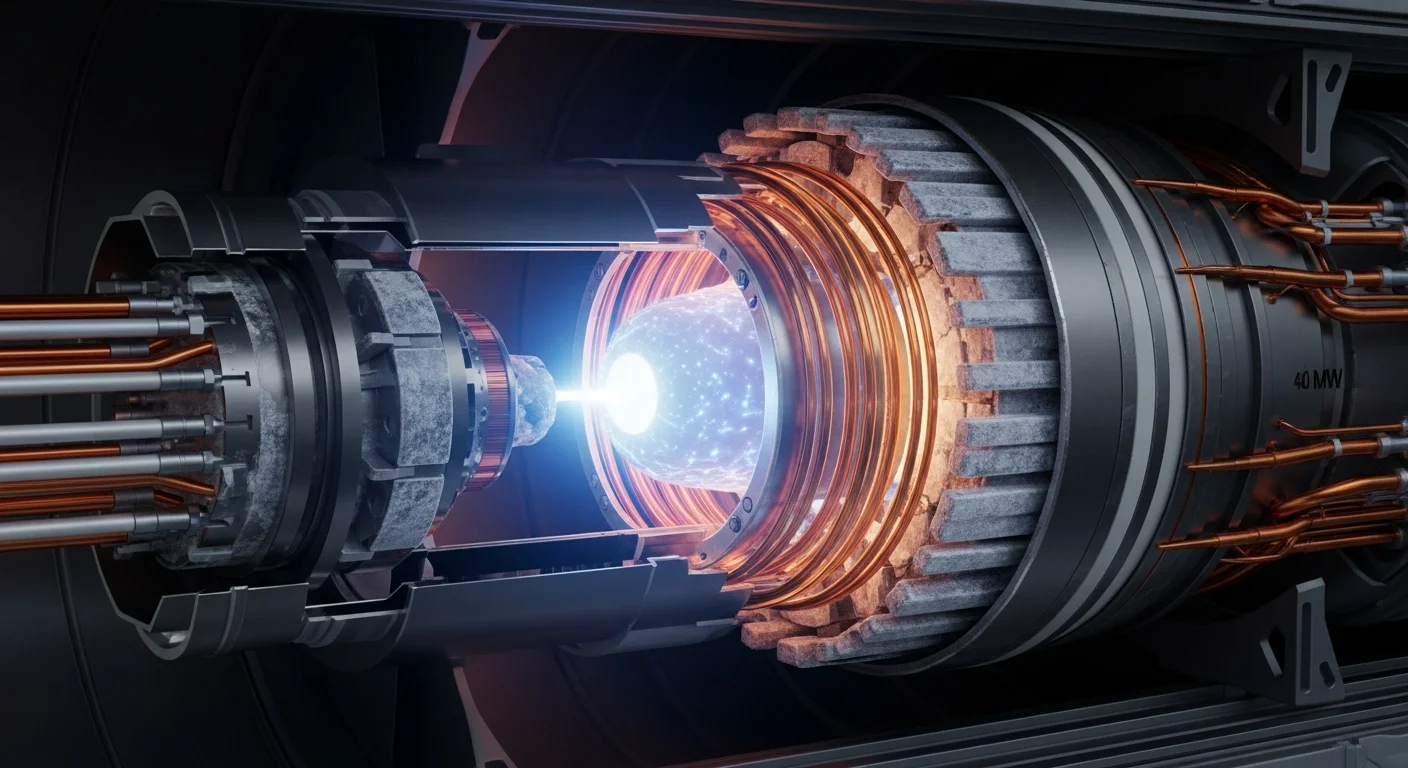
STELLAR FURNACE SF-1 — 40 MW CONTINUOUS FROM PROTON-BORON FUSION
The XR-1 requires continuous power at levels no chemical, electrochemical, or radioisotope system can provide at acceptable mass. The Stellar Furnace SF-1 is the only power source in the Laks Industries portfolio that meets the requirement: 40 MW continuous from the aneutronic proton-boron reaction $p + {}^{11}B \rightarrow 3\,{}^4He + 8.7$ MeV. No neutrons means no heavy shielding, no material activation, and no tritium inventory. Direct energy conversion captures the kinetic energy of the charged alpha particles at 70–80% efficiency — no steam turbine, no thermodynamic cycle loss.[24]
HONEST ASSESSMENT: No proton-boron reactor at any scale has achieved net energy gain. The SF-1 specifications are target parameters for a reactor that does not yet exist. The XR-1 program timeline is gated by SF-1 maturation. The dense plasma focus approach is a legitimate research pathway — pulsed compression achieves the extreme temperatures p-¹¹B demands more readily than magnetic confinement — but the gap between current laboratory demonstrations and a flight-rated 40 MW reactor is measured in decades.
| SUBSYSTEM | STEADY-STATE POWER |
|---|---|
| Thrust (hover, minimum) | 8 MW |
| Plasma ionization (60 GHz / e-beam via Maxwell Continuum gyrotron) | 2 MW |
| Primary coil cryogenics | 800 kW |
| Hull thermal management | 400 kW |
| Trim coil drivers (1,224 segments) | 122 kW |
| Life support and avionics | 50 kW |
| THz gyrotron array (512 units) | 26 kW |
| Terfenol-D actuation layer | 18 kW |
| MPU digital twin | 8 kW |
| Total (hover) | ~11.4 MW |
| Total (full thrust) | ~35 MW |
Startup energy — 5 MW for 300 ms to drive the initial DPF pinch — is provided by a 1,500 MJ supercapacitor bank in Shell 2. The capacitor bank also buffers transient demand spikes during instability rejection and trans-medium transitions. SF-1 pulse rate: 50 kHz, synchronized to every tenth Terfenol-D cycle to prevent beat-frequency interference between fusion pulses and bubble control.
TRANS-MEDIUM TRANSITION PROTOCOLS
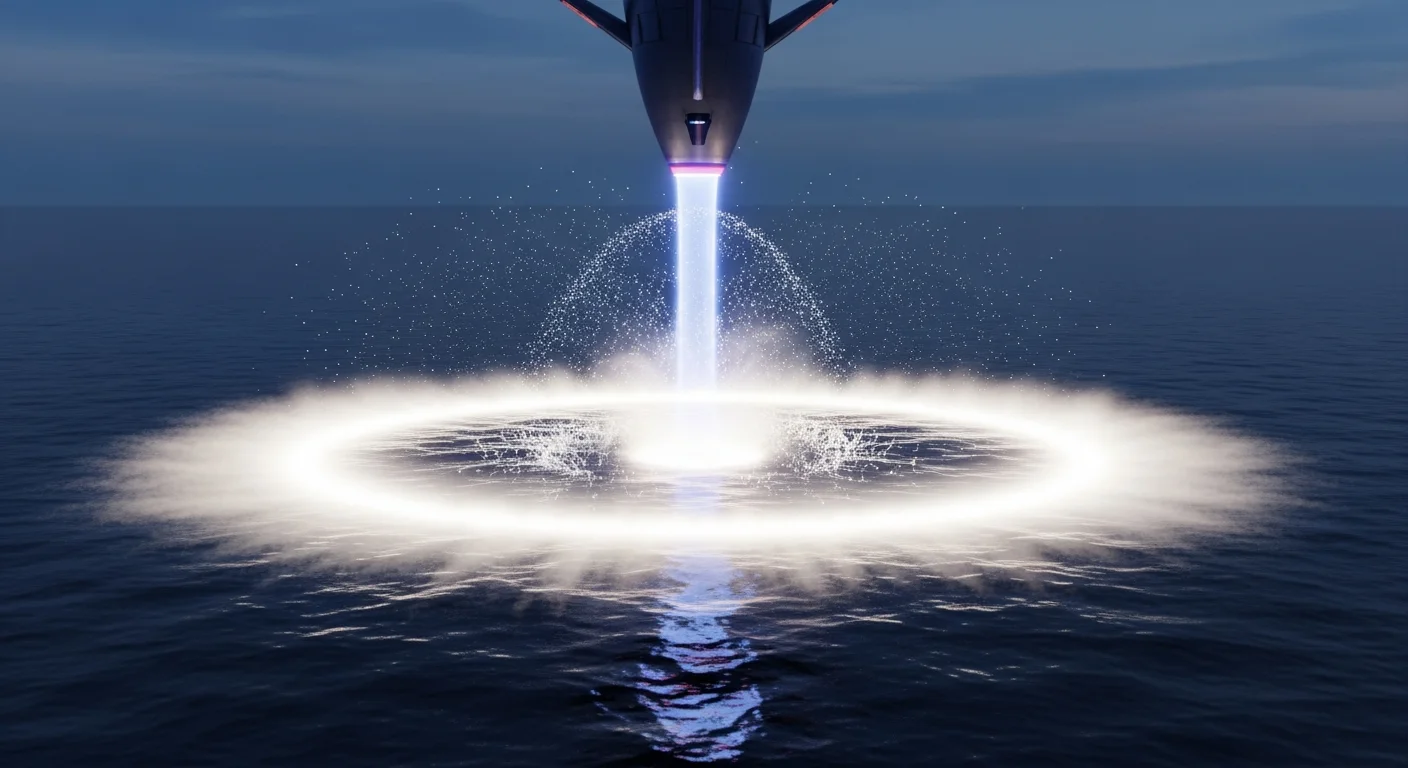
ATMOSPHERE TO OCEAN — THE MOST DEMANDING TRANSITION
Atmosphere to water is the hardest transition. Maximum approach velocity: 50 m/s. The control system contracts the bubble from 4 m to 3 m, switches ionization from microwave to electron beam, primes xenon bridging injection, and redirects the thrust vector downward. At contact, the sheath vaporizes seawater into steam plasma, maintaining continuity. If the approach is too fast, the vaporization front cannot keep pace and the sheath disrupts. Post-transition stabilization: 2 seconds as the control system adapts to the denser medium through the Thomson scattering calibration loop.
Water to atmosphere: faster than entry. Maximum exit velocity: 80 m/s. Steam plasma transitions to air plasma as the bubble clears the surface. Total transition: 0.5–1 s.
Atmosphere to space: gradual. Atmospheric density decreases continuously with altitude. At 80 km the 60 GHz ionization threshold is crossed and the system switches to electron beam with cesium injection. The bubble shrinks as external pressure drops. MHD thrust diminishes. Ponderomotive drive becomes the sole mechanism above 200 km. Orbital insertion from sea level at 3g sustained: approximately 8 minutes, ~28 MW power draw.
FLEET ARCHITECTURE
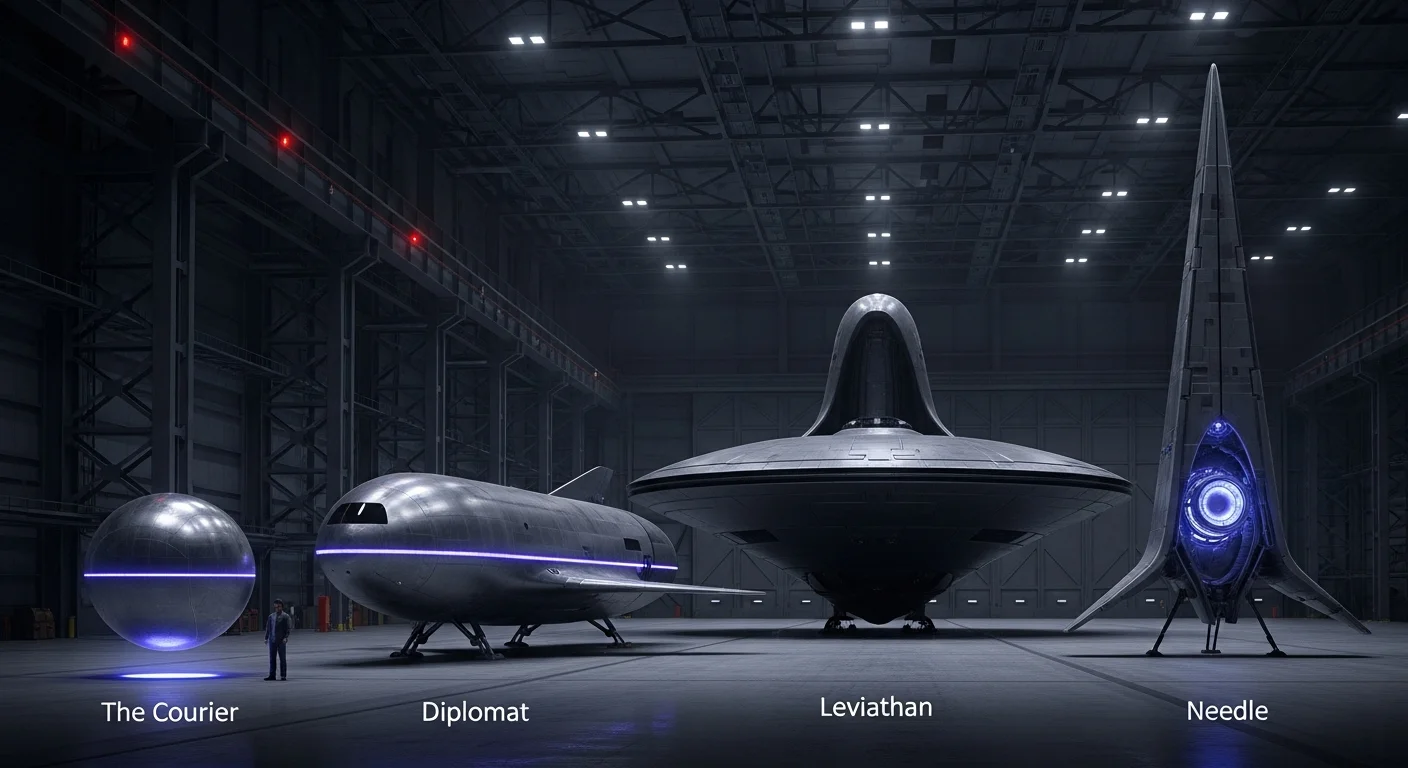
THE FLEET — COURIER / DIPLOMAT / LEVIATHAN
Tier 1: The Courier (Orb Class). One-meter diameter, 50 kg payload, battery-powered at 500 kW. Operated autonomously by the Fermat Logistics platform with Aetheric Sciences flight management AI. Mach 0.5 cruise, Mach 2 sprint, 500 km range, 4-hour endurance. Urban logistics at 300 m altitude — below commercial airspace, above terrain. The plasma envelope makes it radar-invisible, which is both an operational advantage and a regulatory problem.
Tier 2: The Diplomat (Pill Class). The XR-1 Ring Class — 7.5 m diameter, SF-1 powered, six passengers. New York to Tokyo in 55 minutes at Mach 20 cruise. Conventional glass cockpit with the ROM handling all low-level control allocation — the pilot commands heading, altitude, and speed; the vehicle computes the physics. Brainwave Systems Halo neural interface is a Block 2 research track for direct neural piloting, not the primary interface. The Phantom is the military variant on the same airframe. Its operational profile is not publicly documented.[25]
Tier 3: The Leviathan (Disc Class). 100-tonne payload in a lenticular hull. Trans-oceanic submerged transit at 300 knots — Los Angeles to Shanghai in 14 hours underwater. Competitive with air freight on cost-per-tonne-kilometer once SF-1 production cost decreases. The Leviathan’s economics are gated by the same SF-1 maturation that gates the entire program.
A Tier 4 interplanetary class (the Needle) is defined at the conceptual level — crew of 12, 500 MW Stellar Furnace Tier 4 reactor, Mars transit in approximately 50 days. The power budget for sustained thrust does not close with a single reactor at the acceleration profiles desired. The Needle is a research horizon, not a development target.[26]