04 // Propulsion
THE PONDEROMOTIVE DRIVE — THE CRAFT THAT FALLS FORWARD
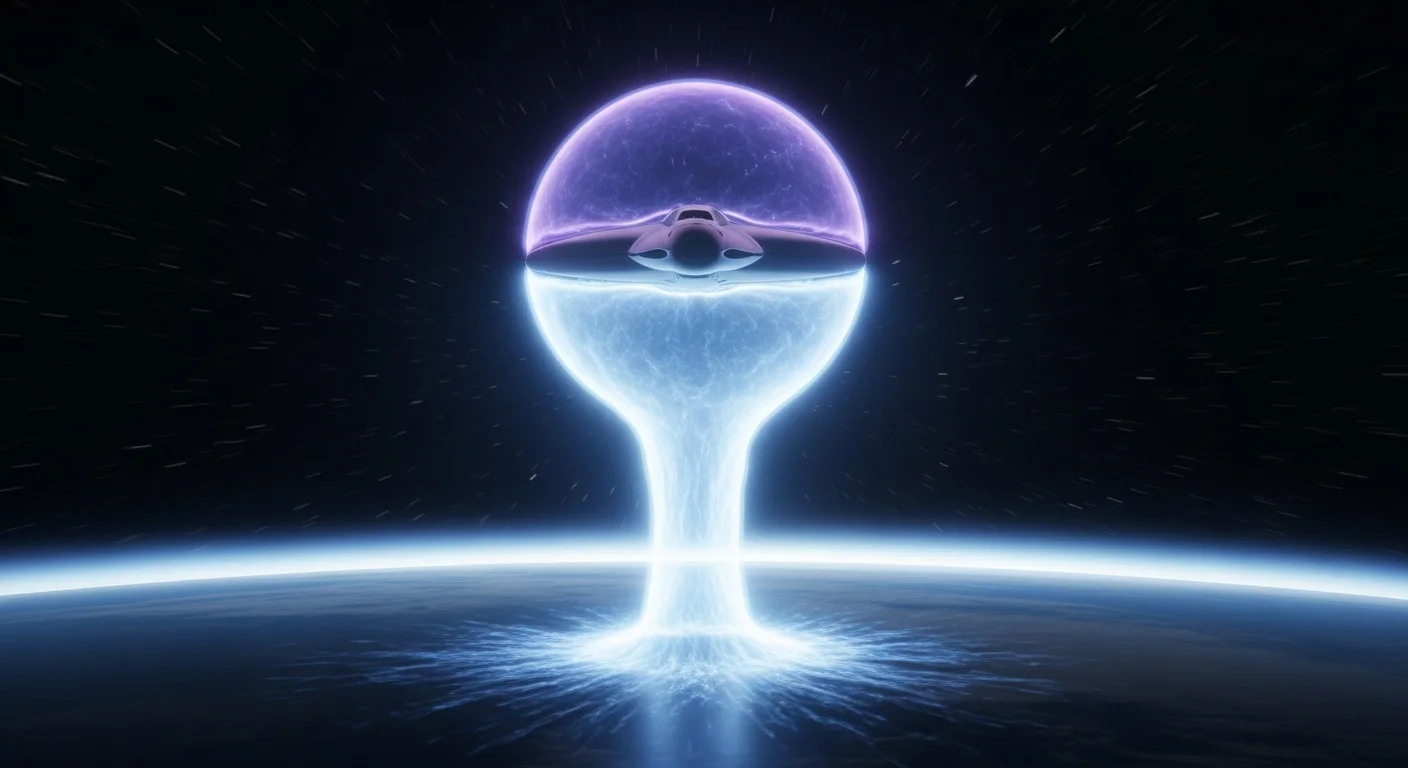
FIG 4.0: PONDEROMOTIVE THRUST — ASYMMETRIC FIELD ENERGY PRODUCES NET FORCE
Consider a charged particle of mass $m$ and charge $q$ in an oscillating electromagnetic field with slowly varying amplitude $\mathbf{E}_0(\mathbf{x})$. Decompose the motion into slow drift and fast oscillation, expand to second order, and time-average. The result is the ponderomotive force:[17]
$$\mathbf{F}_{\text{pond}} = -\frac{q^2}{4m\omega^2}\nabla|\mathbf{E}_0|^2$$
Three properties make this force the basis of the XR-1 propulsion system. First: it is always directed from strong field toward weak field, regardless of charge sign. Both electrons and ions are pushed in the same direction. The force does not cancel between species — the entire plasma moves as one. Second: it scales as $1/\omega^2$ — lower-frequency fields produce stronger ponderomotive forces at the same amplitude. The 500 kHz system generates four orders of magnitude more ponderomotive force than THz fields of equal amplitude. Third: it depends on the spatial gradient $\nabla|\mathbf{E}_0|^2$, not the field itself. A uniform field produces zero force. Thrust requires asymmetry.[17]
For a plasma in an oscillating field, the ponderomotive force integrates to a ponderomotive pressure at the bubble boundary equal to half the electromagnetic energy density:
$$P_{\text{pond}} = \frac{B_0^2}{4\mu_0}$$
At $B_0 = 5$ T: $P_{\text{pond}} \approx 5\times10^6$ Pa — five megapascals, fifty times atmospheric pressure. More than sufficient to confine the bubble against any external environment. The net thrust on the vehicle is the integral of the ponderomotive pressure asymmetry over the bubble surface. For a bubble of radius $r = 4$ m with 1% fore-aft field asymmetry:
$$F_{\text{thrust}} \approx \Delta P_{\text{pond}} \times \pi r^2 \approx (0.01)(5\times10^6)(\pi)(16) \approx 2.5\text{ MN}$$
2.5 meganewtons from 1% asymmetry at 5 Tesla. The XR-1 Ring Class at 12,000 kg has a weight force of 118 kN. Thrust-to-weight: approximately 20:1. This number is not exotic physics. It is the magnetic pressure formula, the bubble geometry, and a small asymmetry. The ponderomotive drive delivers extraordinary thrust-to-weight because magnetic pressure at Tesla-scale fields is enormous and the bubble surface area is large.[18]
The force couples to the hull through void generation — the Maxwell stress tensor integrated over the hull surface. The asymmetric ponderomotive pressure creates a region of lower field energy density ahead of the craft and higher energy density behind. The Maxwell stress tensor transmits this energy gradient as a net force on the hull, directed forward into the low-energy region. The hull is pulled by the field gradient in the bubble interior while the plasma boundary is pushed by ponderomotive pressure on the exterior. Both effects act in the same direction.
THREE OPERATING REGIMES
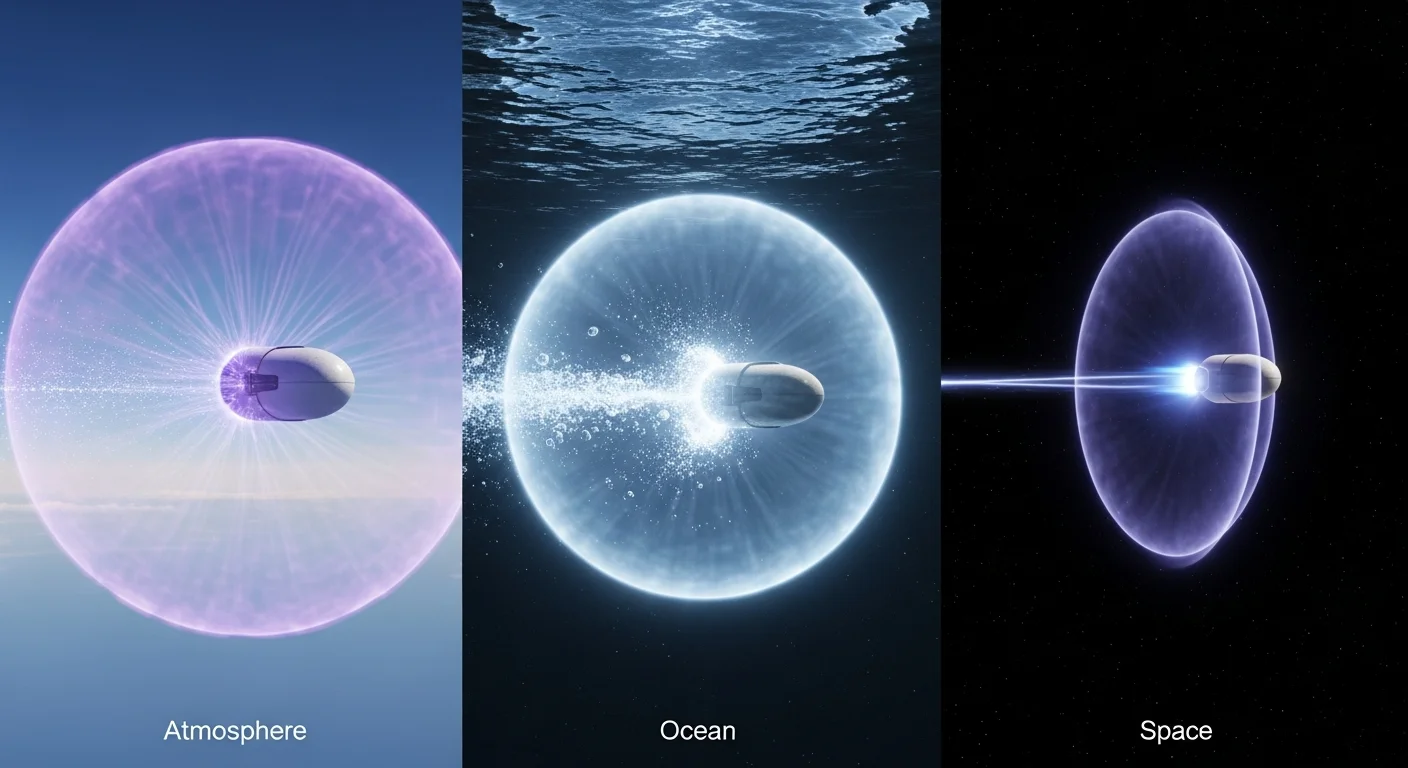
THREE MEDIA, ONE VEHICLE — THE PHYSICS ADAPTS
Atmosphere. Ponderomotive pressure confines and shapes the bubble. $\mathbf{J}\times\mathbf{B}$ MHD forces act on the ionized external air, pushing it rearward while the craft recoils forward — Newton’s third law satisfied conventionally. Electrohydrodynamic (EHD) ion acceleration contributes at low speeds. Combined atmospheric thrust at sea level: approximately 3.5 MN. Zero to Mach 1 in 0.4 seconds. The plasma envelope absorbs the shock wave that would otherwise produce a sonic boom — the bubble’s thermal gradient dissipates the pressure discontinuity before it reaches the external medium. The craft is supersonic and silent.[18]
Ocean. The plasma bubble vaporizes seawater at the boundary, converting it to steam plasma and maintaining the sheath through a denser medium. The vaporization occurs in a thin annular ring at the bubble equator, not across the full frontal area. Sustained submerged operation at speed requires burst power beyond the steady-state reactor output; the supercapacitor bank provides the transient margin. Maximum submerged speed: 300 knots. Maximum depth: unlimited — the bubble maintains interior pressure against any hydrostatic load. The craft can hover underwater where a conventional supercavitating torpedo would stall. Medium transition time: 2–5 seconds for bubble reconfiguration.[19]
Exoatmospheric. Above approximately 80 km altitude, atmospheric density drops below the 60 GHz ionization threshold. The ionization system transitions from microwave to electron beam, and the cesium seed gas loop activates. Cesium ions circulate through the magnetic field structure, are accelerated rearward by the ponderomotive field gradient, decelerate against the field on the opposite side of the loop, and return to the hull for electromagnetic recapture and re-injection. The loop is not perfectly closed — recapture efficiency is approximately 94%, requiring a slow cesium bleed from reserves. But it transforms the propellant budget from a consumable mass fraction problem into a maintenance problem. Specific impulse in open-cycle mode (no recapture): $I_{sp} \approx 3{,}900$ s for cesium at 10 kV acceleration — comparable to advanced Hall thrusters without grid erosion. In closed-loop mode, effective $I_{sp}$ is much higher because most of the working fluid is recovered.[8]
Thrust vector control requires no moving parts. The 192 secondary coils provide full three-dimensional thrust authority through a $3\times192$ allocation matrix pre-computed by the digital twin. Given a desired thrust vector, the required coil current distribution is found by solving an overdetermined linear system with redundancy used to impose thermal limits and stability margin constraints. Thrust vector rotation rate: approximately 10,000 degrees per second — instantaneous by human perception.