02 // The Soliton
WHY THE BUBBLE DOES NOT DISPERSE
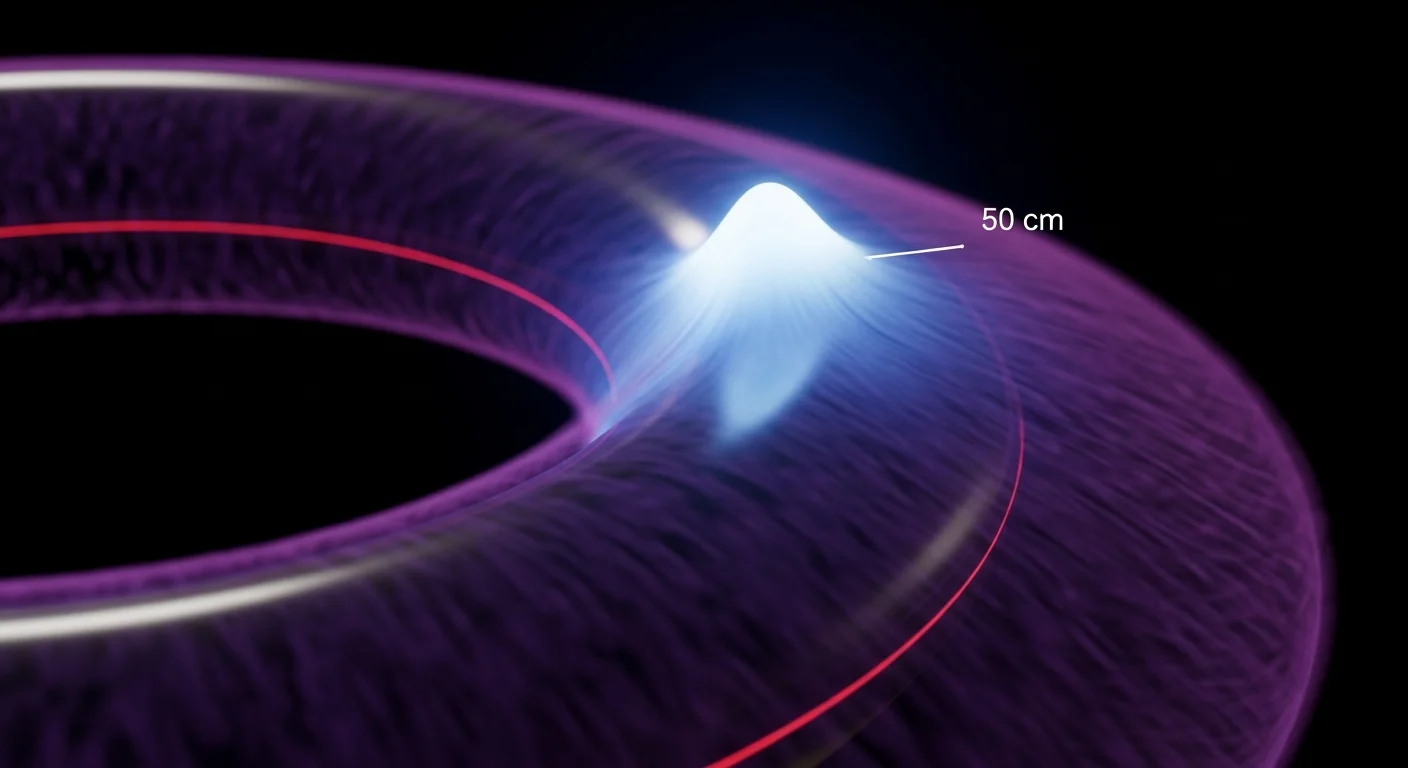
FIG 2.0: SOLITON STRUCTURE — NONLINEAR STEEPENING BALANCES DISPERSIVE SPREADING
A localized plasma configuration — a region of enhanced density and magnetic field surrounded by lower-density plasma — is subject to two competing effects. Dispersion spreads the structure: different wavenumber components travel at different phase velocities, causing initially sharp boundaries to broaden and flatten. Left uncorrected, any localized configuration disperses on the Alfvén timescale and disappears. This is the default behavior of magnetized plasma. It spreads out and dies.
The second effect is nonlinear steepening. In a nonlinear medium, wave amplitude affects propagation velocity. High-amplitude regions travel faster than low-amplitude regions, causing the wave profile to steepen — the leading edge becomes sharper rather than broader. In a plasma at the operating conditions of the XR-1, the nonlinearity is strong enough to counteract dispersion.
A soliton is the exact configuration in which these two effects precisely cancel. It is not a design choice. It is the unique stable solution to the nonlinear MHD wave equation at the operating parameters.[9]
For the one-dimensional case, the governing equation for the magnetic field perturbation $b = B - B_0$ takes the form of the derivative nonlinear Schrödinger equation:
$$\frac{\partial b}{\partial t} + v_A \frac{\partial b}{\partial z} + \alpha b\frac{\partial b}{\partial z} + \beta\frac{\partial^3 b}{\partial z^3} = 0$$
The terms in order: linear propagation at the Alfvén velocity, nonlinear steepening with coefficient $\alpha$, and dispersion with coefficient $\beta$. The soliton solution is:
$$b(z,t) = b_0\,\text{sech}^2\!\left(\frac{z - v_s t}{\Delta}\right), \quad \Delta = \sqrt{\frac{4\beta}{\alpha b_0}}$$
The sech² profile is the soliton signature. Its width is inversely proportional to the square root of its amplitude: taller solitons are narrower, shorter solitons are broader. This is the self-organizing property. If a perturbation broadens the structure, amplitude drops and the configuration resists further broadening through negative feedback. If a perturbation compresses it, amplitude rises and nonlinearity sharpens it back. The soliton is an attractor — not a fragile equilibrium, but a state the system returns to when disturbed.[9]
THREE DIMENSIONS AND THE TOROIDAL TOPOLOGY
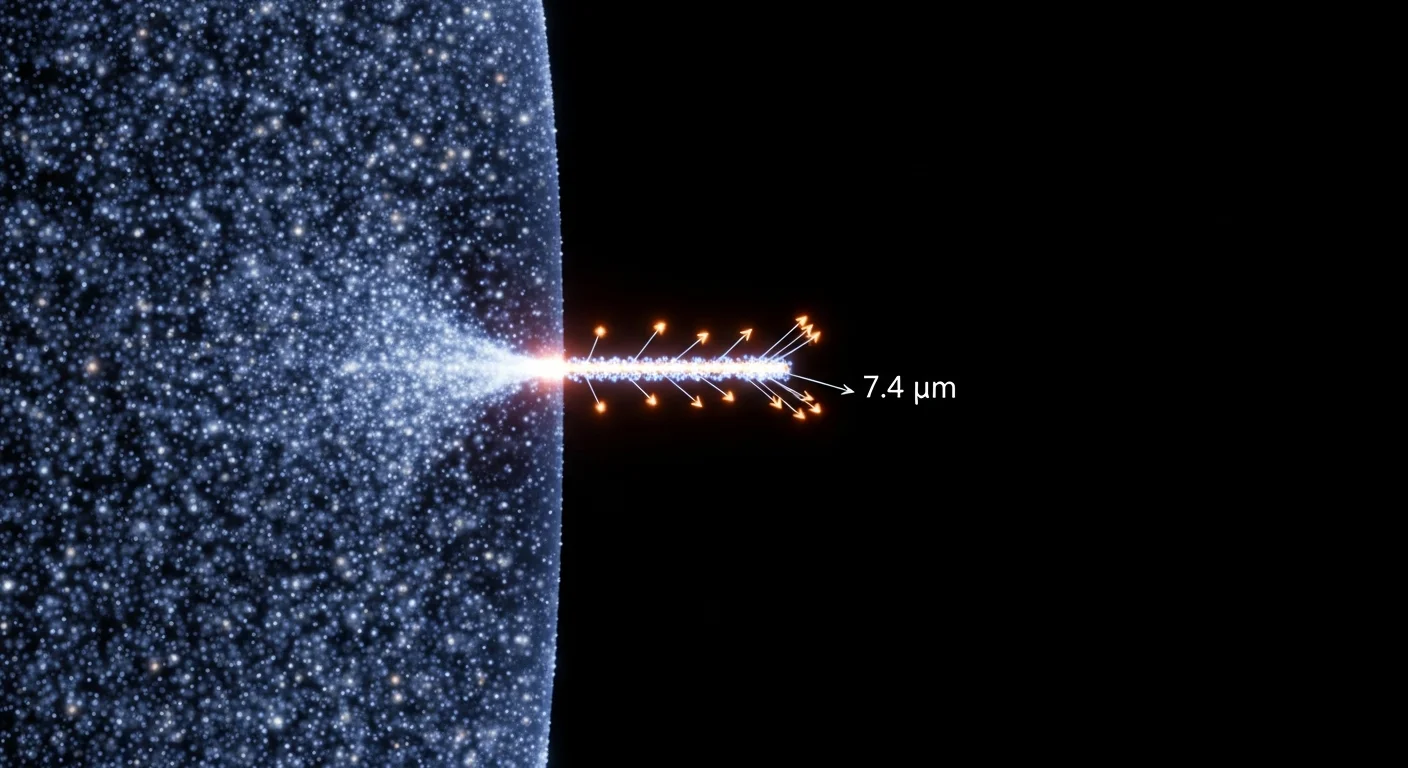
THE DEBYE SHEATH — 7.4 MICROMETERS BETWEEN PLASMA AND ATMOSPHERE
The one-dimensional soliton is a traveling pulse. The plasma bubble is a three-dimensional standing structure. Extending the soliton concept from one to three dimensions is the central theoretical challenge of the program, and the reason the toroidal field topology is not arbitrary — it is the only three-dimensional geometry in which a magnetic soliton can close on itself and persist as a standing wave without a propagation direction.[10]
The Kadomtsev-Petviashvili (KP) equation extends the soliton dynamics to two dimensions. The full three-dimensional closure requires the toroidal topology enforced by the XR-1’s ring-plus-needle coil architecture — primary toroidal coils establishing the closed field-line geometry, with the needle providing the poloidal field component that prevents the toroid from drifting. The bubble geometry is determined by the field topology. The field topology is determined by the coil arrangement. The coil arrangement is determined by the requirement that the soliton close on itself.
The outer boundary of the soliton bubble is the Debye sheath — the 7.4 μm transition layer derived in Section 01 where quasi-neutrality breaks down and the plasma potential transitions to the external medium. The Bohm criterion governs ion entry into the sheath:
$$v_B = \sqrt{\frac{k_B T_e}{m_i}} \approx 2{,}600\text{ m/s}$$
At a sheath ion current density of approximately 400 A/m² across the 200 m² bubble surface, the total sheath maintenance current is roughly 80 kA. This current — and the power it represents — is a primary design driver for the hull and power system. The sheath is also the surface on which the THz metamaterial control system operates: surface plasmon polariton modes propagating along the plasma-vacuum interface at THz frequencies, modulated by the hull’s Bi-Mg metamaterial layer to control local charge density at sub-millimeter resolution.[3]