Archive · Technical report · XR1-TR-003 · REV B
Governing equations
Ideal magnetohydrodynamics is the wrong model for sea-level air. The right one is simpler, and less forgiving.
REV A of this note began where plasma textbooks begin: a hot, tenuous, fully ionized gas in which collective electromagnetic behaviour dominates and the field is frozen into the fluid. That is the plasma of stars, tokamaks and the solar wind. The working fluid of XR-1 is different in kind. It is sea-level air in which roughly one molecule in twenty-five million carries a charge. REV B keeps the equations REV A introduced, then removes, one by one, the assumptions that do not survive contact with the atmosphere. What remains is the model the test program has to confirm or break.
The ideal set
Ideal magnetohydrodynamics treats a conducting gas as one fluid coupled to the magnetic field:
Four assumptions are built in: collisions are negligible compared with collective motion, the conductivity is effectively infinite, the field moves with the fluid, and the field is shaped by currents in the fluid itself. Established physics Each one fails in the atmosphere, and each failure changes what the actuator must do.
What sea-level air changes
1 · Collisions dominate
At the reference state the electron plasma frequency is $\omega_{pe}=5.64\times10^{10}$ rad/s and the electron–neutral collision frequency is $\nu_{en}\approx2\times10^{12}\,\mathrm{s^{-1}}$, about 35 times higher. An electron collides dozens of times during one would-be plasma oscillation. There are about 4,900 particles in a Debye sphere, so the gas is still quasi-neutral and screens charge over $\lambda_D=10.5\,\mu$m; but collective oscillation is overdamped, and the right description keeps electrons, ions and neutrals as distinct, strongly coupled species. Established physics
2 · The field does not move with the air
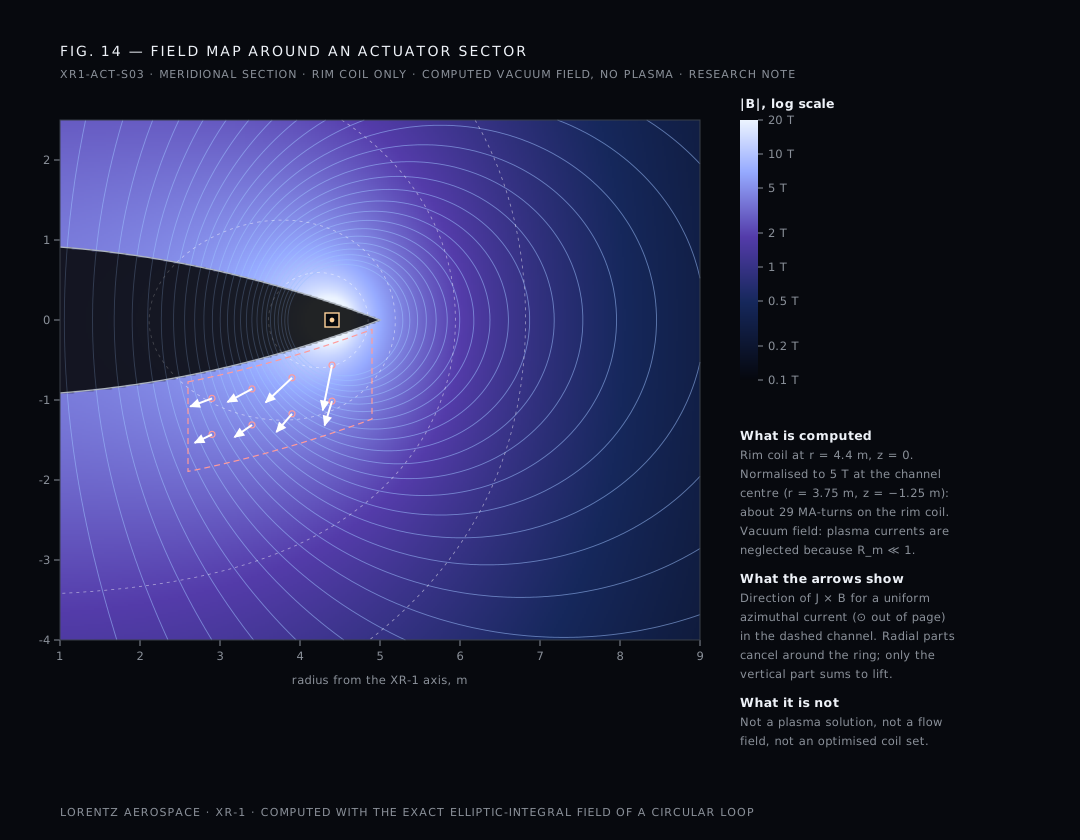
The magnetic Reynolds number at hover, $R_m=\mu_0\sigma UL$, is about $3\times10^{-5}$ even at an optimistic 1 S/m. The field produced by the discharge's own current, of order $\mu_0JL\approx5\times10^{-4}$ T at the reference current density, is one ten-thousandth of the 5 T applied field. The induction equation collapses: $\mathbf B$ is the vacuum field of the coils, computed once, and the air moves through it without dragging it anywhere. Established physics
3 · Ohm's law acquires structure
$\mathbf E+\mathbf u\times\mathbf B=0$ is replaced by a finite, anisotropic conductivity. With electrons marginally magnetized ($\beta_e\approx0.44$ at 5 T) and ions not magnetized at all, current follows $\mathbf J=\boldsymbol\sigma\cdot(\mathbf E+\mathbf u\times\mathbf B)$ with Pedersen and Hall components. The derivation and numbers are in the actuator section. Finite conductivity means every ampere carries a Joule cost, and conductivity itself decays by attachment within nanoseconds unless it is continuously bought. Established physics
4 · Waves do not organize the flow
Take the most favourable case, in which ions and neutrals move together and the inertia a magnetic disturbance must move is the whole air, $\rho\approx1.2\,\mathrm{kg/m^3}$. The Alfvén speed is then
and the Lundquist number $S=\mu_0\sigma v_AL$ is about $5\times10^{-3}$ at 1 S/m over a metre. With $S\ll1$ the disturbance diffuses before it propagates. Faster disturbances fare no better: ions collide with neutrals $10^9$ to $10^{10}$ times a second and cannot move independently of them at all. REV A derived a microsecond control clock from an Alfvén transit through a tenuous plasma; in sea-level air there is no propagating wave to clock. Control timescales come from discharge physics and measured response, as in Control without surfaces. Established physics
5 · Beta is small, for the gas that matters
The pressure of the charged species, $n_ek_BT_e\approx0.32$ Pa, is about $3\times10^{-8}$ of the 9.95 MPa magnetic pressure at 5 T. The neutral gas pressure, 101 kPa, is about 1%. Neither regime resembles the high-beta, self-organizing plasma REV A assumed. Field and plasma do not co-determine the geometry: the coils determine the field, and the discharge fills it.
The working set
What survives is a low-$R_m$, quasi-static, multi-species model. The field is imposed; the electric potential and current satisfy charge conservation; the electron density is made and lost locally; and the neutral gas feels the force and the heat:
The force term is the one that names the company. At the reference current density of 392 A/m² in 5 T it is about 1,960 N/m³, or 1,600 m/s² per kilogram of air in the interaction region, and across a 50 m³ useful volume it is the 98.1 kN hover load. The heat term is its price, and the electron-balance term is the price of being able to pay it. Coupled plasma-chemistry, electrical and flow solvers of this form are what XR1-SIM-001 requires to reproduce a measured discharge before its vehicle predictions count. Simulation target
Where magnetic pressure acts
Using Ampère's law, the Lorentz force density splits into a pressure gradient and a tension along curved field lines:
The identity is exact, and easy to misread. In the air around the coil the field is almost curl-free, because the discharge current is tiny compared with the coil current. There the two terms are each large and cancel almost exactly; what survives is only $\mathbf J\times\mathbf B$ with the small current the discharge carries. The pressure $B^2/2\mu_0$ does its real work where $\nabla\times\mathbf B$ is large: inside the windings, as hoop stress on the conductor and its structure. Established physics
That is also where the reaction goes. The force the field exerts on the air current is matched by an equal and opposite force on the coil currents. The vehicle is pushed through its magnet structure; the air is pushed through its own current. Thrust exists only if that momentum leaves in the external air.
Revision notes
REV A mixed correct textbook relations with parameters and conclusions from a different plasma. The corrections are the useful part of this record.
| REV A (2025) | REV B |
|---|---|
| Collisions negligible; the plasma behaves as an ideal conducting fluid | $\nu_{en}\approx35\,\omega_{pe}$; collisional, multi-species, finite conductivity |
| Debye length 7.4 μm at 2 eV | 10.5 μm at 2 eV; 7.4 μm corresponds to 1 eV |
| Plasma frequency "56 GHz" | $5.64\times10^{10}$ rad/s, which is $f_{pe}=8.98$ GHz |
| Frozen-in field lets a compact coil hold a structure many times its size | $R_m\sim10^{-5}$; the field is the coils' vacuum field and nothing is carried with the air |
| Alfvén transit sets a microsecond control clock | Alfvén disturbances are overdamped ($S\ll1$); control timescales come from measured response |
| High beta, 0.5 to 2 | About $10^{-2}$ for the neutral gas and $3\times10^{-8}$ for the charged species at 5 T |
| The 60 GHz oxygen band couples directly into ionization | That band is a molecular absorption; it heats. Ionization at millimetre wavelengths proceeds by electron heating and impact, as on the working-fluid section |
| Caesium seed gas and vacuum operation | Alkali seeding is a real technique of combustion MHD generators. XR-1 works in ambient air and carries no seed |
The equations of a star are elegant. The equations of sea-level air are the ones that have to be paid for, watt by watt, in Gate 01.