10 // Prior Art Review: US 3,322,374 (King, 1967)

Lorentz Aerospace — 10 // Prior Art Review: US 3,322,374 (King, 1967) Lorentz Aerospace — 10 // Prior Art Review: US 3,322,374 (King, 1967) Lorentz Aerospace — 10 // Prior Art Review: US 3,322,374 (King, 1967) Lorentz Aerospace — 10 // Prior Art Review: US 3,322,374 (King, 1967)

TECHNICAL LINEAGE — MAGNETOHYDRODYNAMIC PROPULSION APPARATUS

Every engineering programme has ancestors. The Lorentz Aerospace plasma-bubble propulsion architecture did not emerge from vacuum. It descends from a lineage of magnetohydrodynamic propulsion concepts that begins in the late 1950s and reaches its most coherent early expression in United States Patent 3,322,374, granted May 30, 1967 to James F. King, Jr. of Winston-Salem, North Carolina. The patent is titled “Magnetohydrodynamic Propulsion Apparatus.” It describes a heavier-than-air craft propelled by the interaction of moving magnetic fields with a self-generated plasma sheath surrounding the vehicle. It is, to our knowledge, the first patent filing that correctly identifies and formally claims the complete operating principle: ionise the atmosphere, induce eddy currents in the resulting plasma via a traveling polyphase magnetic field, and extract propulsive thrust from the Lenz’s-law reaction force.

King got the physics right. What he did not have — could not have had, in 1964 — were the materials, the power systems, the control architectures, or the computational tools to build what he described. This section reviews the patent in detail, identifies the specific engineering limitations imposed by the technology of its era, and maps each limitation to the Laks Industries division whose contemporary capability resolves it. The purpose is not to diminish the original work. It is to demonstrate that the gap between King’s concept and a buildable vehicle is precisely the gap that the Lorentz Aerospace supplier network exists to close.

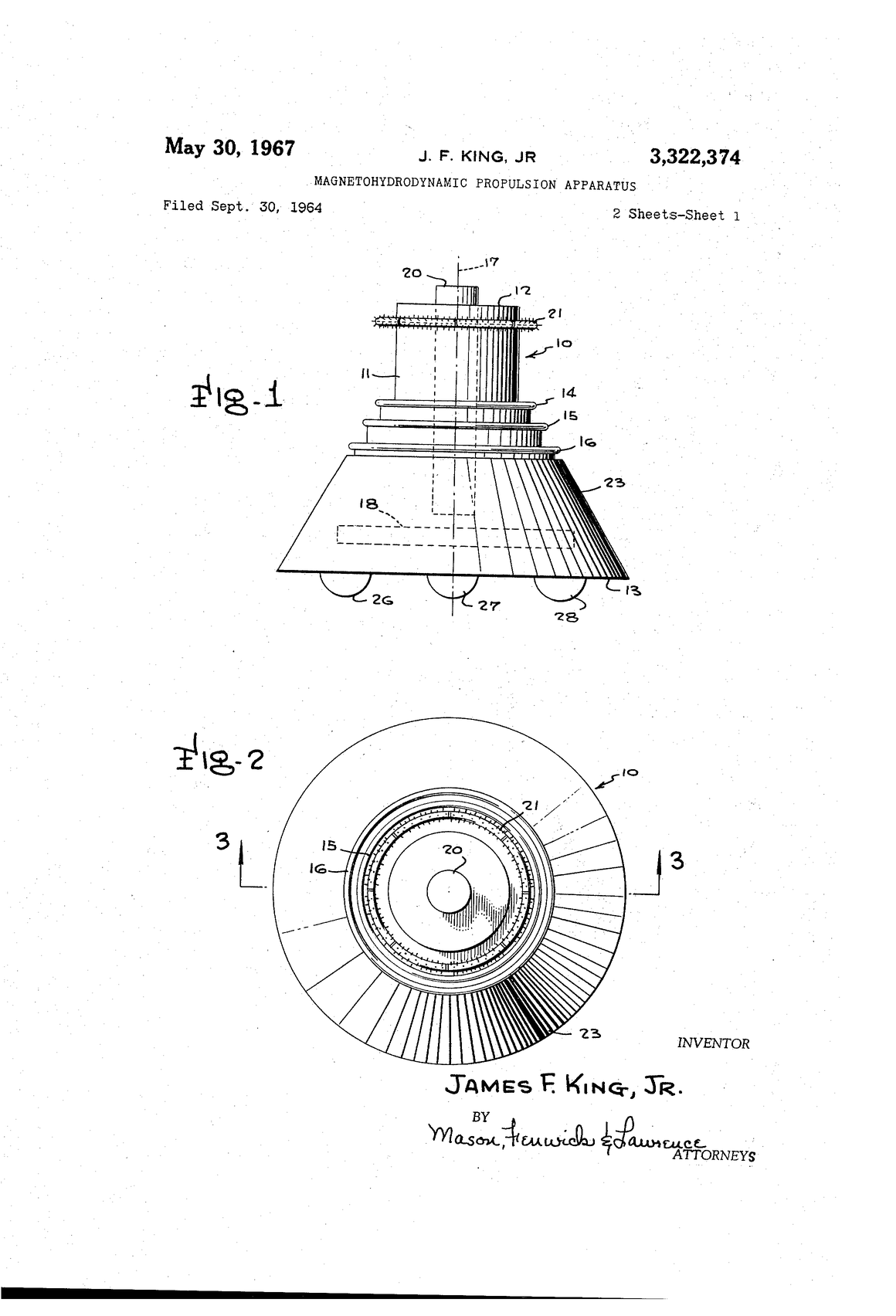
US Patent 3,322,374 — Drawing Sheet 1: Side elevation and top view of MHD propulsion craft showing conical driving ring arrangement, ionizer ring, and frustoconical air-directing skirt
US 3,322,374 — SHEET 1 OF 2. Side elevation (FIG. 1) and top view (FIG. 2) of King’s MHD craft. Note the axially stacked driving rings (14, 15, 16) of progressively increasing diameter, the ionizer ring (21) at the leading end, the ferrite core pole piece (20) along the central axis, and the frustoconical air-directing skirt (23) below the driving rings. The craft is oriented vertically with thrust directed downward.
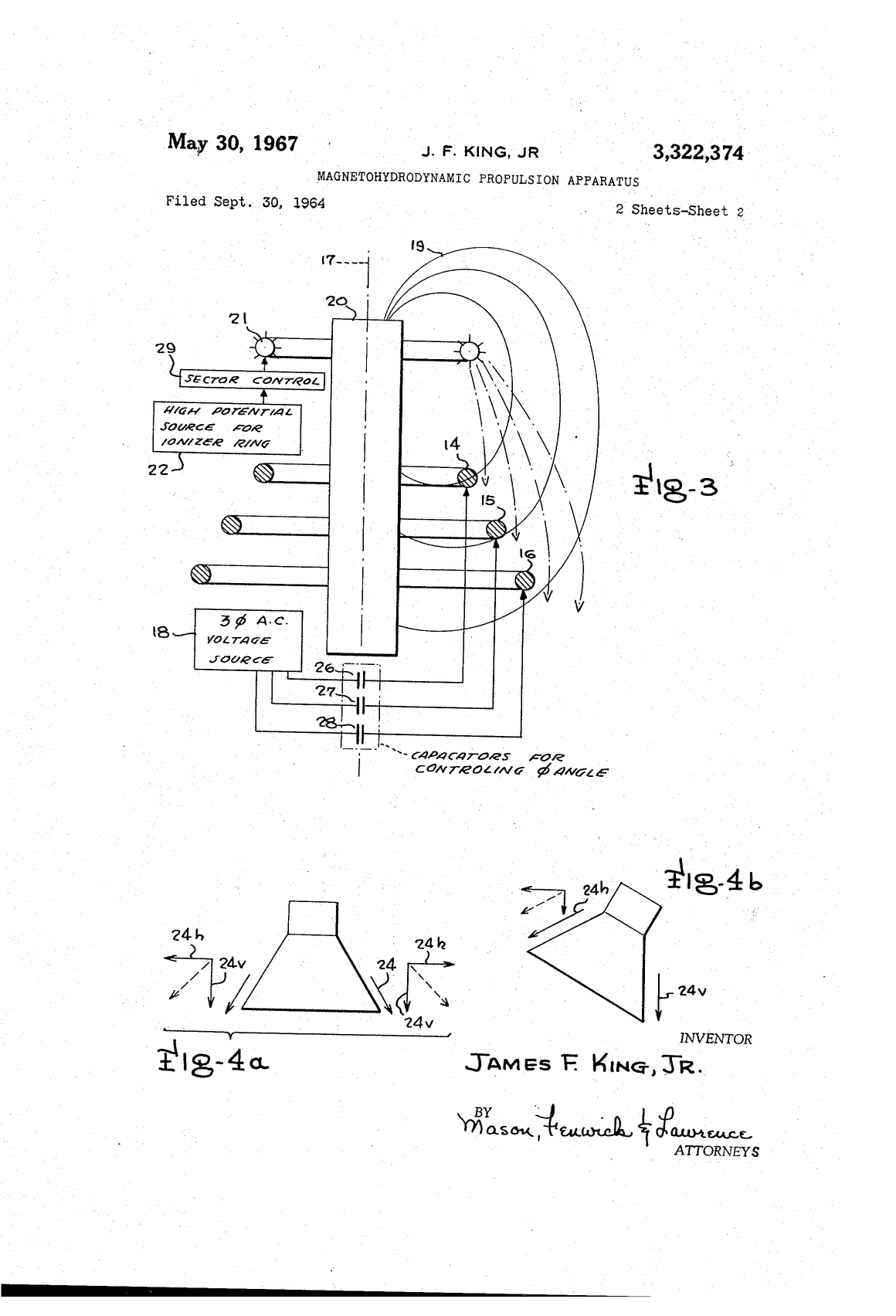
US Patent 3,322,374 — Drawing Sheet 2: Skeleton diagram of driving ring magnetic field configuration and vector force stability diagrams at vertical and tilted attitudes
US 3,322,374 — SHEET 2 OF 2. Skeleton diagram (FIG. 3) showing traveling magnetic field lines (19) produced by polyphase-excited driving rings. FIGS. 4a and 4b illustrate the self-stabilising vector geometry: at vertical attitude (4a), horizontal force components cancel symmetrically; at tilted attitude (4b), asymmetric force vectors produce a restoring couple. This is the dihedral-equivalent stability mechanism.

The Patent: What King Proposed

King’s craft is a vertically oriented fuselage with three principal subsystems. At the leading end (top), an ionizer ring — described as a ring of spikes at alternating potentials — generates a corona discharge that ionises the surrounding air into a conductive plasma annulus enveloping the vehicle. Along the body of the craft, a series of polyphase driving rings — single-turn superconducting coils of progressively increasing diameter — carry heavy alternating currents phased to produce a traveling magnetic field whose point of maximum flux density sweeps continuously from the leading end to the trailing end and resets. A ferrite pole piece along the central axis converts the air-core coils to a ferrite-core system, increasing flux density. At the trailing end, a frustoconical air-directing skirt channels the ionised airflow outward and downward.

The operating principle is that of a linear induction motor with the atmosphere as the rotor. The traveling magnetic field induces eddy currents in the plasma annulus by mutual induction. Per Lenz’s law, the induced currents oppose the motion of the field that produced them. The plasma is therefore driven in the direction of the traveling field — downward and outward — and the reaction force propels the craft upward. The conical geometry of the driving rings and the frustoconical skirt together produce a downward-diverging thrust pattern that provides passive stability analogous to dihedral in winged aircraft: when the craft tilts, the force vectors on the lower side resolve vertically while those on the upper side resolve near-horizontally, producing a restoring couple that returns the craft to its reference attitude.

King specifies superconducting driving rings for minimum resistance and maximum field strength, with series-resonant capacitors to correct the power factor from pure inductance to unity. The ionizer ring is segmented into independently controllable arcuate sectors, permitting quadrant-by-quadrant variation in ionisation intensity for directional control. An alternative steering method uses switchable shorting coils in the skirt that, when closed, absorb power from the primary field and locally reduce thrust in the corresponding quadrant.

The patent also notes — with considerable foresight — that the same propulsion principle applies to any electrically conductive fluid medium, explicitly citing seawater, and that for operation outside the atmosphere, the craft would need to carry its own ion source. Nine claims are filed, covering the general MHD propulsion method, the specific conical driving-ring geometry, superconducting ring construction, the frustoconical stability skirt, and the segmented ionizer steering system.[27]


Assessment: What King Got Right

The patent is remarkable for several things it identifies correctly, most of which were not obvious in 1964 and some of which remain underappreciated today.

The atmosphere as armature. King understood that if you can ionise air to sufficient conductivity, you can treat it as the moving conductor in a linear motor. This is the foundational insight of atmospheric MHD propulsion. He does not rely on ion wind (electrostatic thrust from migrating charged particles, as in Brown’s electrokinetic patents) or on J×B body forces from DC current paths through the plasma (as in the earlier British Patent 830,816). He uses mutual induction — a traveling AC magnetic field generating eddy currents in a conductive medium — which is the correct high-efficiency mechanism for bulk momentum transfer to a fluid conductor. This distinction matters enormously. Ion wind produces micronewtons. Eddy-current MHD interaction, at sufficient field strength and plasma conductivity, produces forces that scale with the square of the magnetic field intensity and the conductivity of the medium. The scaling laws are favourable in a way that electrostatic methods are not.

The linear-motor analogy. By framing the propulsion system as a linear induction motor, King connects MHD propulsion to a well-understood engineering discipline with decades of prior art in catapults, electromagnetic pumps, and projectile launchers. This is not just a conceptual convenience — it means the phase relationships, the traveling-field mathematics, and the equivalent circuit models are already worked out. The plasma annulus is the short-circuited secondary of a polyphase induction machine. The slip, the induced EMF, the force-speed characteristic — all follow from standard induction motor theory applied to a fluid conductor.

Passive geometric stability. The progressively increasing ring diameter and the frustoconical skirt together create a thrust geometry that is inherently self-stabilising. King works through the vector analysis explicitly in Figures 4a and 4b: at vertical attitude, the horizontal components cancel; at any tilt, they produce a restoring moment. This is the rotational equivalent of dihedral stability in fixed-wing aircraft, achieved without any active control system. It is elegant and it is correct.

Dual-path steering. King proposes two independent steering mechanisms: varying ionisation by quadrant (controlling the conductivity of the secondary), and varying the magnetic field by quadrant using switchable shorting coils (controlling the primary). This is a rudimentary form of the principle that attitude control in an MHD vehicle requires independent modulation of both the plasma state and the driving field. The principle is sound even though the implementation is crude.


Assessment: What 1964 Could Not Provide

The gap between King’s patent and a flyable vehicle is not a gap in physics. The physics is correct. It is a gap in eight specific engineering capabilities, each of which maps to a contemporary Laks Industries division.

1. Superconductor performance. King specifies superconducting driving rings but the only superconductors available in 1964 were low-temperature Type II materials — niobium-titanium and niobium-tin — requiring liquid helium cooling at 4.2 K. The critical current density, the quench margin, and the achievable field strength were all marginal for the application. A cryogenic system massive enough to maintain helium temperatures in an atmospheric vehicle would consume most of the craft’s payload and power budget.

Resolution: Highfield Magnetics REBCO (Rare Earth Barium Copper Oxide) high-temperature superconducting tape operates at liquid nitrogen temperatures (77 K) or above, with critical current densities and field strengths that exceed NbTi by an order of magnitude at equivalent temperatures. The cryogenic penalty drops by a factor of fifty. The driving rings become practical.

2. Power source. King specifies “a suitable source” for the polyphase AC currents and the ionizer voltage. No such source existed in 1964 at the power density required. The driving rings demand megawatt-class AC power at precisely controlled frequency and phase. The ionizer demands high-voltage DC. Both must be sustained continuously during flight. No battery, no fuel cell, and no turbine generator of the era could deliver this in an airborne package of acceptable mass.

Resolution: Stellar Furnace compact reactor — a molten-salt fission system providing tens of megawatts thermal, converted to electrical power through Phase Flash thermoelectric and magnetohydrodynamic generators. The reactor provides continuous, fuel-independent power at power densities no chemical source can match.

3. Plasma generation and sustainability. King’s ionizer is a corona-discharge spike ring — essentially a high-voltage static eliminator scaled up. Corona discharge ionises air, but weakly and inefficiently. The resulting plasma conductivity is marginal for MHD interaction. The ionisation decays rapidly (recombination timescale in atmospheric-pressure air is microseconds), requiring continuous re-ionisation of the entire working volume. King acknowledges this implicitly by placing the ionizer at the leading end and relying on the plasma to persist long enough to interact with the driving rings further down the body. At the conductivities achievable by corona discharge, the eddy-current coupling would be very weak.

Resolution: Maxwell Continuum provides two complementary ionisation systems. High-power RF excitation from the H-Array sustains a volumetric plasma at conductivities orders of magnitude above what corona discharge achieves. The Meridian laser platform provides targeted photoionisation for precision plasma shaping. The plasma is not a passive cloud drifting past the vehicle — it is actively maintained, shaped, and conditioned in real time.

4. Control bandwidth. King’s steering mechanisms — segmented ionizer control and switchable shorting coils — are binary or low-resolution analog. The ionizer sectors are either on or off (or at a few discrete levels). The shorting coils are either open or closed. This provides quadrant-level directional control with a response time limited by the switching speed of mechanical or relay-based contactors. For a vehicle that must maintain attitude stability while transitioning between hover, lateral flight, and high-speed cruise, this control bandwidth is inadequate by several orders of magnitude.

Resolution: The Lorentz Aerospace dual-frequency control architecture provides continuous, high-bandwidth field shaping. The 500 kHz MHD breathing mode modulates the bulk confinement geometry at microsecond timescales. The THz sheath-control frequency, supplied by Maxwell Continuum Deep-Look systems, provides sub-millimetre spatial resolution of the plasma boundary. Together they replace King’s quadrant switching with a continuously variable, spatially resolved field-control surface — the equivalent of replacing a four-position switch with a high-resolution touchscreen.

5. Field stability and soliton confinement. King’s traveling magnetic field is a simple polyphase wave. The flux-density maximum sweeps from top to bottom and resets. There is no mechanism for the field geometry to self-reinforce, no nonlinear feedback between the plasma response and the driving field. If external perturbations — gusts, density gradients, turbulence — disturb the plasma annulus, the driving field does not adapt. The system is open-loop with respect to the plasma state.

Resolution: The Lorentz Aerospace confinement architecture uses soliton dynamics — self-reinforcing nonlinear wave structures in which the plasma and the field co-evolve into a stable configuration that resists perturbation. The plasma bubble is not held in place by brute-force external fields. It is a dynamical equilibrium in which the nonlinear interaction between the magnetised plasma and the driving field creates a structure that maintains itself. Perturbations are damped by the same nonlinear dynamics that sustain the equilibrium. The theoretical framework is described in the Lorentz Aerospace white paper, Part I (Soliton Dynamics in Plasma Media). The practical implementation requires the Maxwell Continuum Analog Field Solver for real-time sub-microsecond field computation and the Aetheric Sciences digital-twin simulation running the D2Q9 Lattice-Boltzmann MHD model described in Part II of the white paper.

6. Hull materials. King’s craft is a conventional airframe with coils bolted to it. The fuselage is passive structure — it supports the driving rings and the payload, and that is all. It does not participate in the electromagnetic interaction. The magnetic field must project outward from the coils through an inert hull to reach the surrounding plasma, losing intensity with distance.

Resolution: The Lorentz Aerospace hull is an active electromagnetic surface. Metallic Sciences metamaterial waveguides are integrated into the hull structure itself, guiding and amplifying the driving field. Polymer Press composite hull panels incorporate distributed conductor arrays that function as a continuous phased surface rather than a set of discrete coils. The hull does not merely contain the field — it shapes it. The field geometry is no longer constrained to what a few coaxial rings can produce.

7. Computational modeling. King designed his system with analytical methods — pencil, paper, and the equivalent-circuit models of linear induction motor theory. These are adequate for first-order force estimates but cannot capture the three-dimensional, time-varying, nonlinear interaction between a turbulent plasma and a traveling magnetic field in a realistic flight environment. The stability analysis (Figures 4a/4b) is static — it shows restoring forces at two attitudes but says nothing about dynamic response, oscillation damping, or coupled-mode instabilities.

Resolution: Aetheric Sciences provides the computational infrastructure: the D2Q9 Lattice-Boltzmann MHD digital twin models the full coupled plasma-field interaction in real time. Brainwave Systems sensor fusion provides continuous measurement of the actual plasma state — density, temperature, conductivity, velocity — feeding the model with ground truth. The vehicle does not fly on predicted physics. It flies on measured physics, corrected continuously.

8. Thermal management. King does not address thermal management. A plasma annulus at the conductivities required for effective MHD coupling radiates intensely. The driving rings, even if superconducting, must be shielded from the thermal load of the plasma they are driving. The hull surface in contact with ionised air at thousands of degrees requires active cooling or ablative protection. None of this is discussed in the patent.

Resolution: Phase Flash thermoelectric systems and Vapor Vacuum thermal management provide active heat rejection from the hull and the superconducting coil system. The Maxwell Continuum Kerr-Shield adaptive optics research programme addresses beam-deflection and refractive thermal management for the highest-intensity operating regimes.


Comparative Architecture

SUBSYSTEM KING (1964) LORENTZ AEROSPACE (2026) RESOLVING DIVISION
Driving coils LTS (NbTi), liquid He cooling, discrete rings REBCO HTS tape, LN&sub2 cooling, distributed hull-integrated arrays Highfield Magnetics
Power source “Suitable source” (unspecified) Compact molten-salt fission reactor, 50+ MWth Stellar Furnace
Plasma generation Corona discharge spike ring RF volumetric ionisation + laser photoionisation Maxwell Continuum
Steering Quadrant ionizer sectors + shorting coils (binary) Dual-frequency continuous field shaping (500 kHz + THz) Maxwell Continuum
Field stability Open-loop traveling wave, no plasma feedback Soliton confinement — self-reinforcing nonlinear equilibrium Lorentz Aerospace (architecture)
Hull Passive airframe, coils bolted on Active metamaterial EM surface, distributed conductor arrays Metallic Sciences + Polymer Press
Computational model Analytical equivalent-circuit, static stability analysis Real-time D2Q9 Lattice-Boltzmann MHD digital twin Aetheric Sciences
Sensing None (blind operation) Multi-modal plasma state measurement, sensor fusion Brainwave Systems
Thermal management Not addressed Active thermoelectric + vacuum thermal rejection Phase Flash + Vapor Vacuum
Electrical conversion Not addressed MHD and thermoelectric power conversion Phase Flash

Conclusion

King’s patent is the conceptual root of atmospheric MHD propulsion. The linear-induction-motor analogy, the self-generated plasma sheath, the polyphase traveling field, and the geometric stability mechanism are all correct and all present in the Lorentz Aerospace architecture sixty years later. What separates concept from vehicle is not a single breakthrough but the convergence of eight independent engineering capabilities — superconductors, compact power, plasma generation, high-bandwidth control, nonlinear field dynamics, active hull materials, real-time computational modeling, and thermal management — each of which has advanced by one to three orders of magnitude since 1964.

The Lorentz Aerospace programme does not claim to have invented MHD propulsion. James F. King, Jr. filed the essential concept in September 1964. What Lorentz Aerospace contributes is the systems integration — the identification of every subsystem that must exist between the concept and the vehicle, the specification of each subsystem’s performance requirements, and the assignment of each requirement to a division within the Laks Industries ecosystem that can meet it. The patent is the seed. The supplier network is the soil. The vehicle is what grows when both are present.

US 3,322,374 expired in 1984. The physics it describes is in the public domain. The engineering required to realise it is the work of this division.

END OF TECHNICAL SPECIFICATION

Lorentz Aerospace — lorentzaerospace.com
A division of Laks Industries